How many apps did you go through every morning? Maybe you checked WhatsApp, switched to Uber for a ride price, hopped over to Apple Pay to settle a bill, and then scrolled through DoorDash to pre-order lunch.
By 9:00 AM, you have so far managed to navigate four different interfaces, logged in to different accounts, and shared your data.
Now, what if I say it can be done with a single app, and that too with a single login? Sounds interesting?
Thats exactly where super apps shine. You get to do all your tasks, whether it be a payment, ordering food, booking a taxi, or anything else.
Instead of forcing users to download 20 different apps, firms have started investing in a super app where everything lives under one digital roof.
In this detailed guide, we’ll break down:
What is a super app
Super app architecture
Super app development process
Superapp examples
Super apps tech stack
Why super apps are the future of digital business models
Let’s dive deep.
Table Of Contents
What Exactly is a Super App?
Simply put, a Super App is a mobile platform that provides a suite of seemingly unrelated services under the same digital roof.
No matter what your purpose is, like communication, financial services, e-commerce, and logistics, a super app does it all.
You can assume it as a digital Swiss Army knife. Instead of having a “siloed” app for every task, a Super App uses a modular architecture.
It allows mobile app developers to build mini-programs that users can access without ever leaving the primary interface.
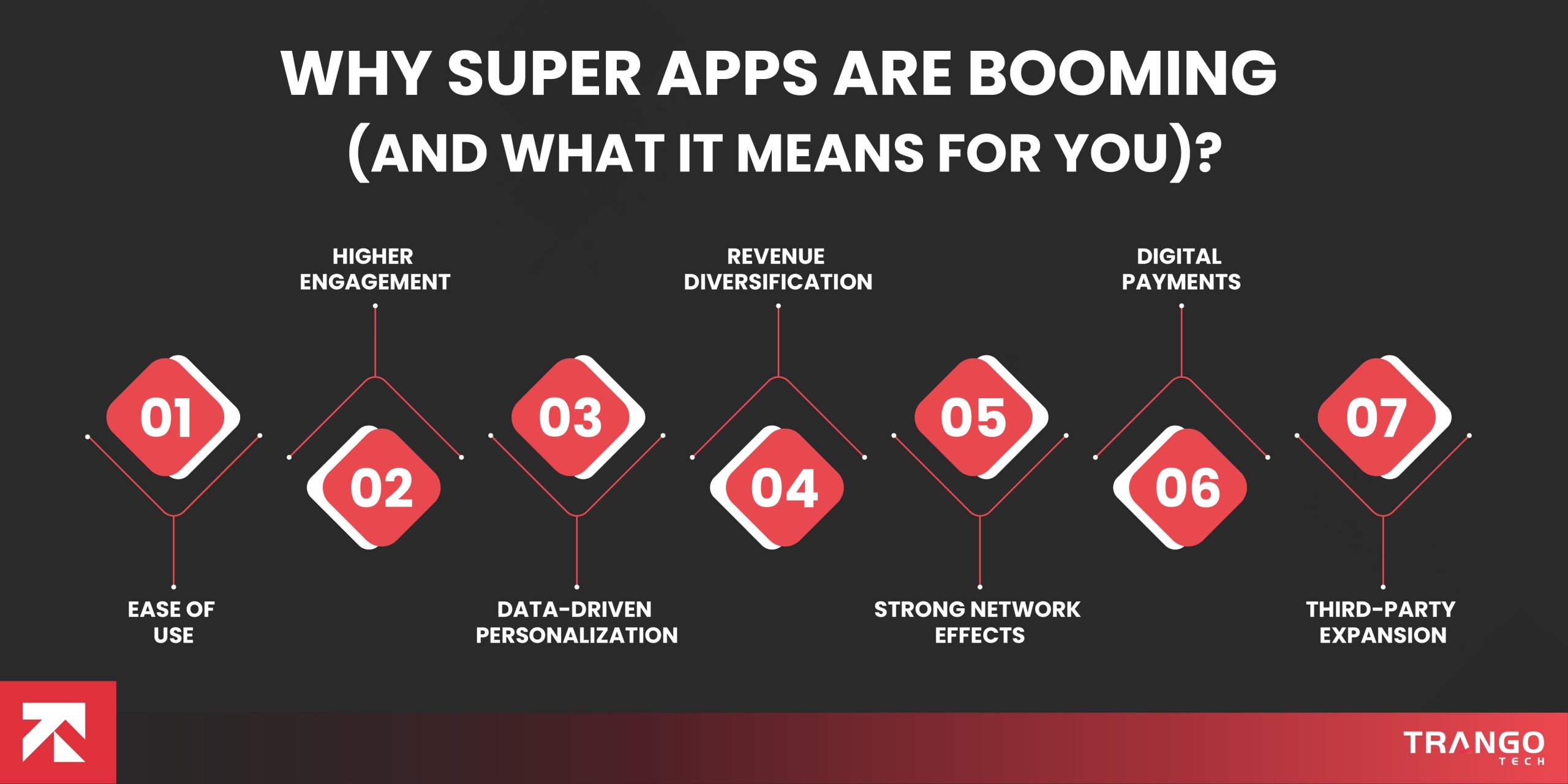
Why Super Apps are Booming (And What It Means for You)?
The term super app started initially as a simple messaging app, but it gradually evolved into an all-in-one place.
In fact, they are rising not by accident. Super applications are on everyone’s lips for their convenience.
Besides that, there are several key reasons for super apps being so popular:
Ease of Use
To be honest, app overload is real. I myself struggle a lot using different apps for different purposes.
It feels weird to have dozens of apps on a phone. Like a separate one for banking, delivery, message, and shopping.
However, wrangling the associated data like passwords, storage, and notifications is very daunting.
Unlike that, a super app removes that friction. You will access everything inside a single ecosystem.
This ease reduces decision fatigue, simplifies daily routines, and creates a smoother digital experience.
Higher Engagement
Traditional applications struggle a lot when it comes to user retention. They download it, use it once or twice, and then forget.
Meanwhile, a super app is completely different. Since it is multipurpose, users tend to stick with it for a long time.
An individual can make use of the same app to send money, book a ride, and order food simultaneously.
The more services there are, the more reasons there are for users to come back.
Data-Driven Personalization
Based on our experience, we consider super apps as a goldmine of user data to collect and analyze
Businesses through this app product get to understand a 360-degree view of behaviour patterns.
They dive into aspects like:
Spending habits
Travel frequency
Shopping preferences
Location behavior
Service usage trends
With these valuable insights, you will tweak your strategy and deliver hyper-personalized recommendations.
For instance, if a user books a ride to the airport, you suggest travel insurance in case of unexpected circumstances.
Revenue Diversification
Since conventional applications rely on a single source of revenue, they fail from the very beginning.
Such a model can limit your growth. In contrast, a super app breaks that limitation through multiple channels.
Like you may get commissions, transaction fees, advertising placements, and embedded fintech services.
With so many options, there is likely a risk of financial drain if one vertical slows, others can compensate.
Strong Network Effects
Bigwigs in super app development like WeChat, Alipay, Grab, and Gojek have strong network effects.
They work relentlessly hard to deliver exceptional value to both users and stakeholders at the same time.
Given the large number of users, merchants, and service providers that connect with it, the app emerges stronger.
You may think of it as a reverse effect, like the bigger the number of vendors, the more customers there will be.
Similarly, the higher the number of customers, the more vendors are making it a self-sustaining cycle.
Digital Payments
One of the most riveting factors behind the immense growth of super apps is embedded finance.
Unlike other types of apps, these apps come with digital wallets, P2P payments, and investment services built in.
Super apps foster a frictionless, native checkout experience by eliminating risky external redirects.
It leads to reduced dependence on third parties, better payment security, and ultimately better customer trust.
Third-Party Expansion
Besides self-growth, super apps act as a third-party resource for other businesses to build inside them.
Through mini-app frameworks and open APIs, developers and companies can integrate their services directly.
Simply put, it can expand the platform without the core company having to build everything from scratch.
Moreover, you don’t have to scale linearly; your app scales exponentially through potential partnerships.
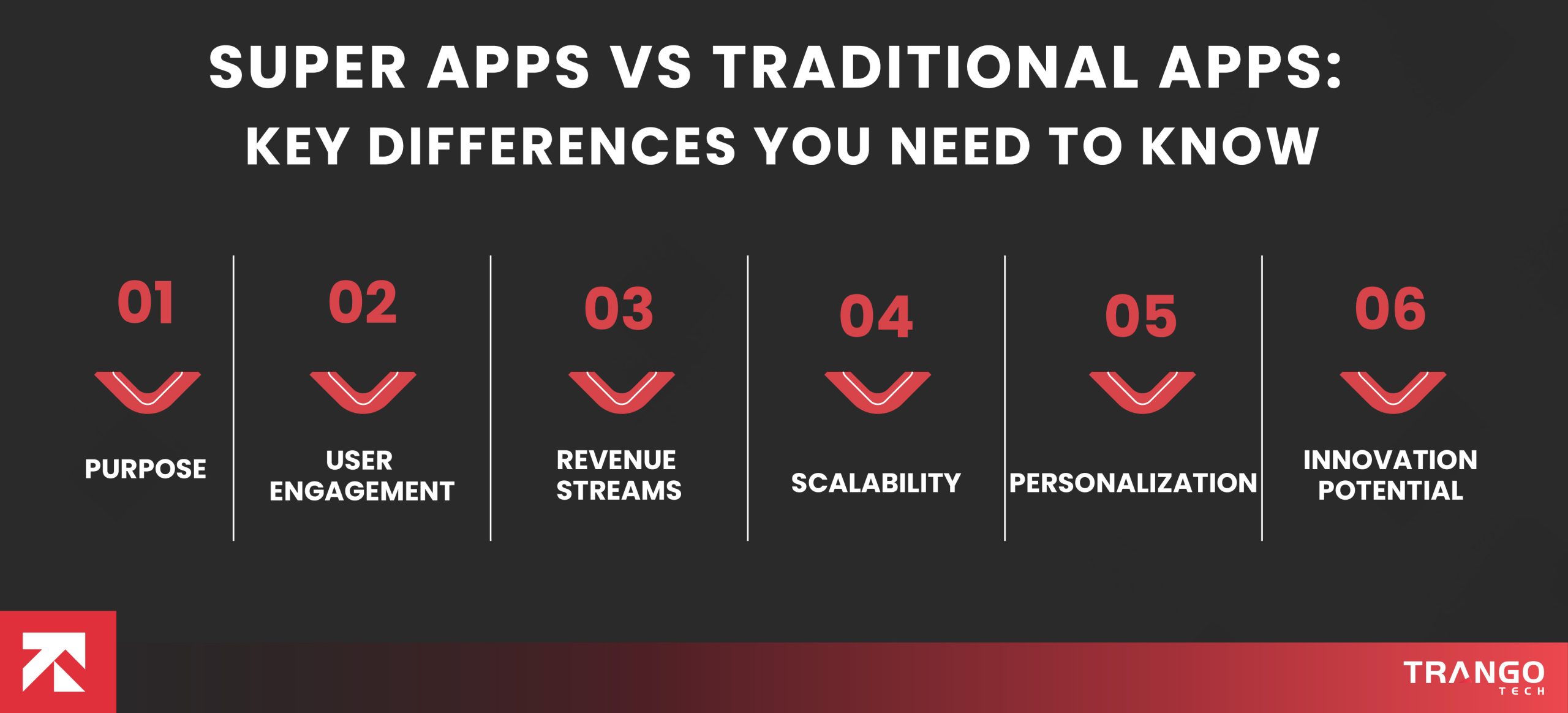
Super Apps vs Traditional Apps: Key Differences You Need to Know
We are living in a digital age, and mobile apps have become central to how we live, work, and interact.
Whether you’re ordering food and booking rides or paying bills, there is nothing we can’t do with apps.
But not all apps are created equal. While traditional apps focus on a single task, super apps integrate multiple services under one platform.
Before you code the next big super app, see how they differ from traditional apps:
1. Purpose
Traditional apps are built with an aim to solve a single problem. For instance, a unique taxi app like Uber serves no other purpose than book rides. The same goes for a food delivery app like Food Panda. It lets you order meals and track them until they reach your plate. To be precise, traditional apps are narrowly designed and do excel at that one task.
On the other hand, super apps aim to cover comprehensive services under one digital roof. You can use it to send messages, book a ride, and make payments effortlessly. Both businesses and users love to rely on a super app for everyday use.
2. User Engagement
Traditional apps usually see limited engagement; only users who want a relevant service use it. They open the app only when they need that specific service. Simply put, they are used sporadically.
In contrast to it, super apps have a much higher user engagement. It comes with a long list of services users want daily, like ride booking, food delivery, and everything in between. For this purpose, the user returns frequently, and the app becomes a constant part of their life.
3. Revenue Streams
Not always true, but conventional apps have mainly one primary source of income. They mostly use either a monetization model, such as subscription fees, in-app purchases, or commissions. If it didn’t work out, you might have drained financially.
Unlike them, super apps have a different source of revenue. It includes transaction fees, advertising, subscriptions, mini-app commissions, and embedded financial services. With such recurring models, going for super apps is resilient and profitable.
4. Scalability
The scalability within traditional apps is quite limited. I mean, you can’t add a new service that means creating a separate app. It leads to a lack of user experience and fragments your reputation.
In contradiction to it, super apps are super scalable. They come up with a modular architecture to integrate new features or mini-apps, that too without disruption. You will have continuous growth and innovation.
5. Personalization
Traditional apps usually offer very limited personalization. They tend to provide what they are built for. There is nothing extraordinary for the user to come back.
While super apps deliver highly personalized experiences through AI technology, you will be analyzing user behavior across numerous services. Based on that data, you may offer recommendations, discounts, and suggestions.
6. Innovation Potential
Innovation through the app is not negotiable. Apps that are developed using conventional practices mainly focus on incremental improvements. Through it, an excellent strategy, but their scope for innovation remains limited.
Following that, super apps are easy to innovate and refine. You may add new services, partnerships, and mini-apps swiftly. It keeps your brands fresh and competitive against rivals.
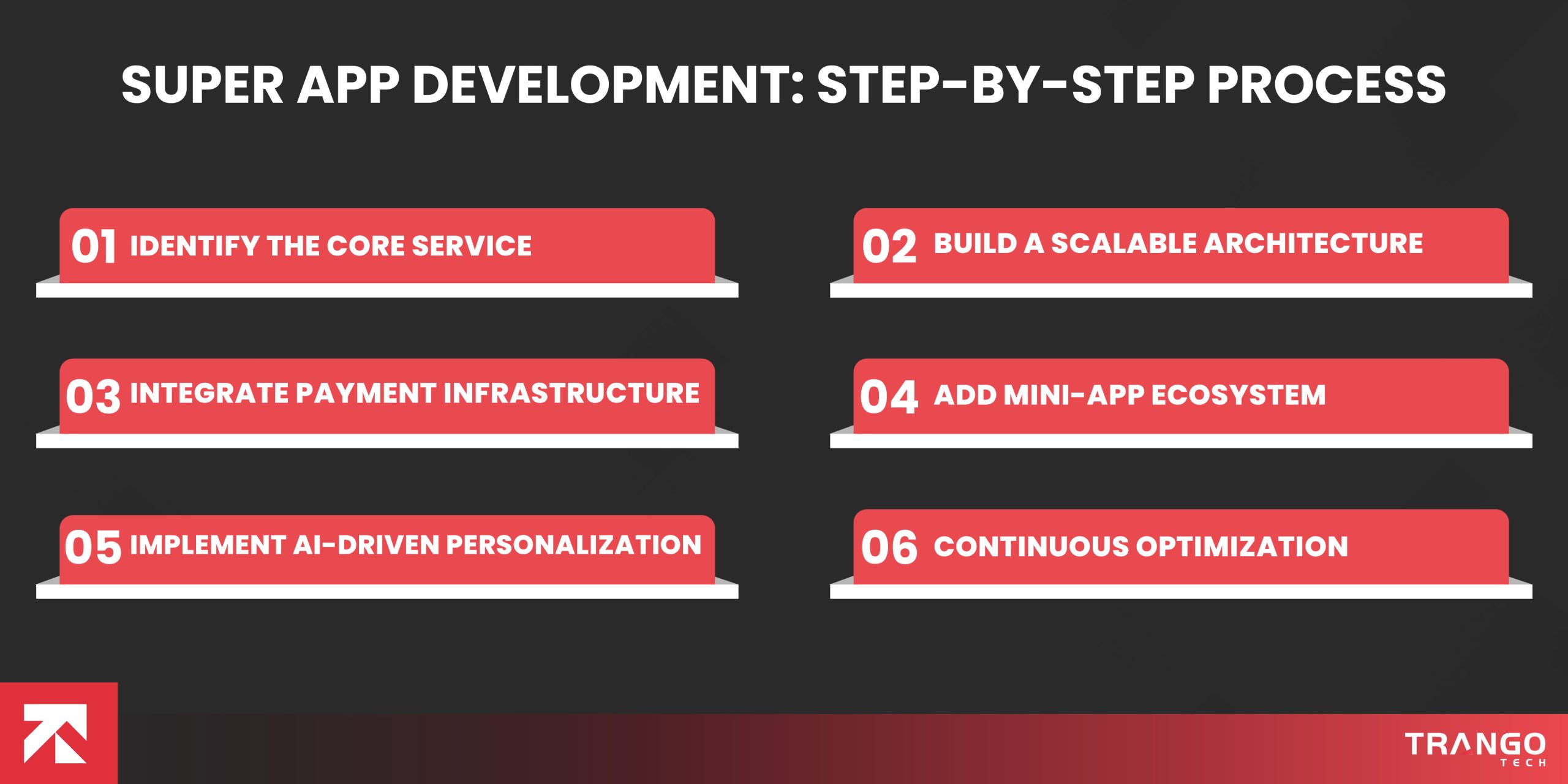
Super App Development: Step-by-Step Process
How do apps like WeChat, Grab, or Gojek manage to do so much more than a typical mobile app?
The reason could be their development strategy. Most of the developers use the same old-school methodology for super apps as well.
Though it was effective to some extent, it may not work ideally for super applications. This is because super app development requires careful planning and innovation.
Below is how you can develop a super app capable of scaling millions of users.
Step 1: Identify the Core Service
Every super app starts with a core service first, and it evolves over time. You can’t do everything at once.
For instance, Grab started with ride-hailing services, and likewise, Gojek began as a motorbike taxi platform.
When you start by targeting a single service, it keeps you focused, and you remain committed to solving a real problem.
Once you feel like having a loyal user base around this core function, you’d better expand into additional services.
Step 2: Build a Scalable Architecture
Your super app might struggle without a scalable infrastructure from the start. This is because legacy monolithic apps cannot handle the load of multiple services.
They will fail to run different services and mini apps simultaneously. For this purpose, they might need to adopt a microservices architecture.
Also, it is paramount to ensure that the existing backend is capable of handling millions of transactions.
If possible, we recommend planning for cloud deployment, load balancing, and redundancy that will be the backbone.
Step 3: Integrate Payment Infrastructure
For a super app, a reliable payment system is non-negotiable. You can’t afford to disappoint users with risky transactions.
Make sure you have an integrated digital wallet for peer-to-peer transfers. Other than that, it should spport support multiple payment options.
For high app security, utilize encryption, fraud detection algorithms, and adhere to regulatory requirements.
Step 4: Add Mini-App Ecosystem
Once you feel a core app is stable, the next step is to gradually expand it through mini apps.
You should now allow third-party developers to support you and tweak or add services right inside your app.
Most importantly, use an open API framework to manage integrations that help you expand in the long term.
Let’s assume you are a delivery platform. By then, you can get in touch with the restaurant to deliver their food.
This is how exactly you increase engagement, enrich the platform, and scale without building everything internally.
Step 5: Implement AI-Driven Personalization
What truly separates super apps from common ones is personalized experiences. Such an app puts AI and machine learning to understand your needs.
Following that, the app suggests services based on past behavior. For instance, they may predict when a user may need a ride, a meal, or a reminder.
Other than that, you can also utilize it later for promotions, discounts, and content to individual preferences.
Step 6: Continuous Optimization
If you think a super app is just a one-off action, you’re only seeing half the picture. There is a lot to come ahead.
To keep your app relevant to market needs, you need to monitor performance and engagement metrics.
If required, you may release regular updates to improve UX/UI, add features, and fix bugs in the super app.
Those who do time-to-time optimization ensure their super app remains competitive, reliable, and relevant.
High-End Tech Stack for Super App Development
Choosing the right set of technologies is paramount for super app development. Since they are way more complex, you can’t work with legacy frameworks.
You need a solid combination of modern frontend, backend, database, and cloud technologies in order to succeed.
The goal is to let Bulsess deliver a unified, reliable, and intelligent user experience at all costs.
Here is a set of suitable technologies you may use for super app development. This tech stack will allow you to build a mobile app that manages millions of users.
Layer
Technologies
Frontend
Flutter, React Native, Swift (iOS), Kotlin (Android)
Backend
Node.js, Golang, Java Spring Boot
Database
PostgreSQL, MongoDB, Redis
Cloud Infrastructure
AWS, Google Cloud, Azure
Key Technologies
Microservices, Kubernetes, Containerization, API Management, AI & Machine Learning, Blockchain
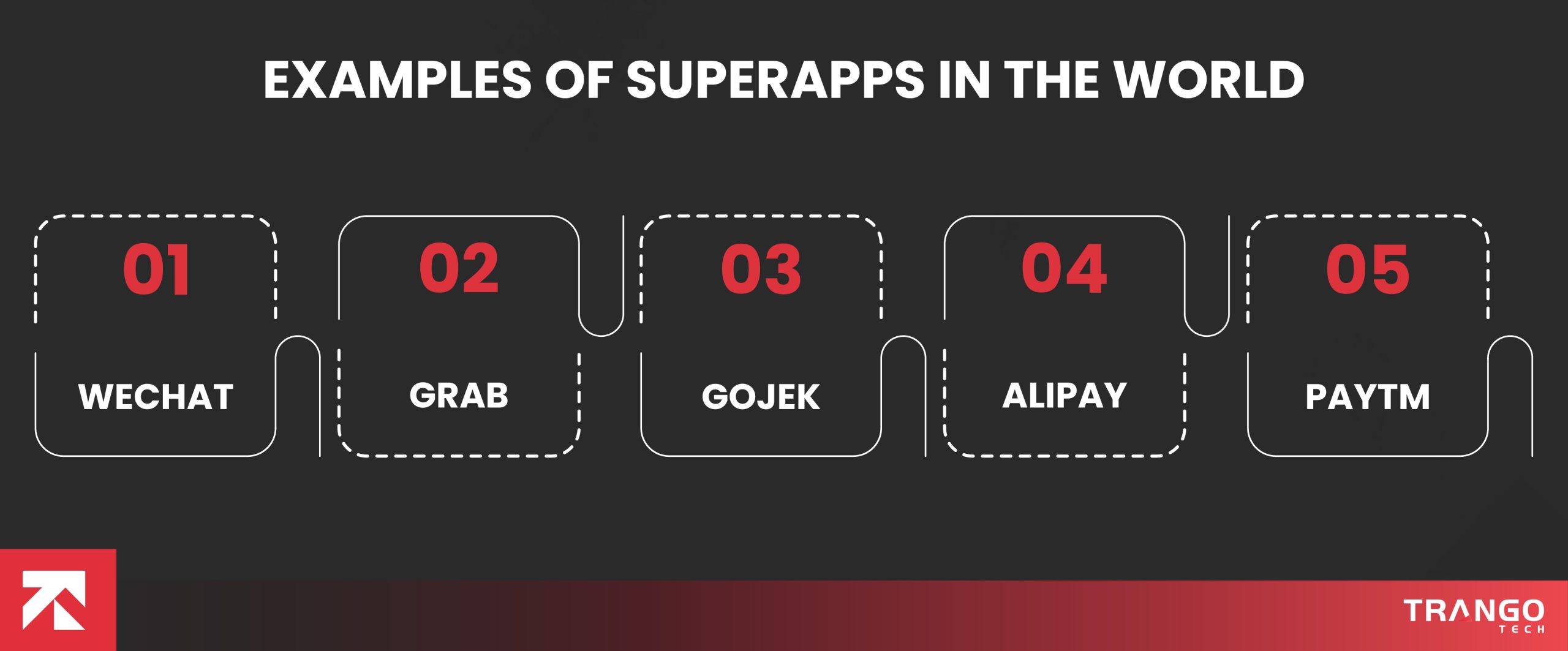
Examples of Superapps in the World.
The super apps have improved the digital lifestyle, work, and interaction of individuals. We can look at some of the most popular super apps in the world. Watch them change digital economies across the whole world.
1. WeChat
WeChat began as a mere messaging app but has rapidly grown into a complete super app. The users today are able to chat, make a voice and video call, transfer money, pay bills, make appointments, and even access government services- all without leaving the app.
Its mini-program ecology gives third-party developers the opportunity to provide services directly through WeChat, which is not only an app but a full-fledged digital ecosystem.
This combination of social, financial, and practical services leaves users interacting every day in order to build a colossal network impact.
2. Grab
Grab was initially a ride-hailing platform in the Southeast Asia region; however, it soon evolved to be a multi-service platform.
Nowadays, Grab users are able to order food, book a taxi, pay bills, transfer money, and get access to financial products such as loans and insurance.
The convenience and localized aspects of Grab also make it a necessity for millions of people throughout the region.
Its combination of transportation, food delivery, and fintech is a perfect example of how one application can be the keystone to everyday life.
3. Gojek
Gojek began as a motorbike taxi application in Indonesia and has expanded to be a multi-service platform providing transport, logistics, payments, and entertainment.
The users have the ability to order groceries, have them delivered, pay digitally, and even stream music or video content.
The integration of useful services with entertainment and financial services helps Gojek retain users and make them reliant on the application to access their daily necessities.
Its popularity demonstrates the ways in which it is possible to build a super app ecosystem by focusing on a core service and then laying off on a strategic basis.
4. Alipay
Alipay started off as an electronic wallet to make safe payments, but has evolved to become an effective super application.
In addition to making transactions, Alipay provides wealth management, insurance, payments, purchasing tickets, and lifestyle services.
The combination of offline and online enterprises enables users to manage virtually all aspects of their personal and financial lives within the Alipay application, which is why it can be considered a template of super apps that merge financial and other mundane services.
5. Paytm
Paytm is a mobile-enabled payment system that began in India but has expanded to become a holistic application in the realm of payments, booking tickets, banking, shopping, and investment.
The Paytm ecosystem allows the user to handle finances, shop online, pay bills, and even book travel, all in one interface.
Its success in India proves the idea of how super apps can be successful in the new markets where convenience, accessibility, and financial inclusion are of paramount importance.
The Core Features of a Successful Super App
The development of a super app does not consist solely of integrating a multitude of features.
In order to be a success, one must develop on a solid background that guarantees an easy user experience, scaling, and a sustained interest.
We have examined the most successful super apps in the world, such as WeChat, Grab, and Gojek.
So far, I have found out that it has four main features that move from a “regular” app to a “super” one.
Feature
Description
Unified Identity
One login (SSO) that works across all mini-services.
Integrated Payments
A native digital wallet that eliminates the friction of re-entering credit card info.
Mini-Program Ecosystem
An open API that allows other businesses to plug their services into the app.
AI-Driven Personalization
Using cross-service data to provide a custom home screen for every user.
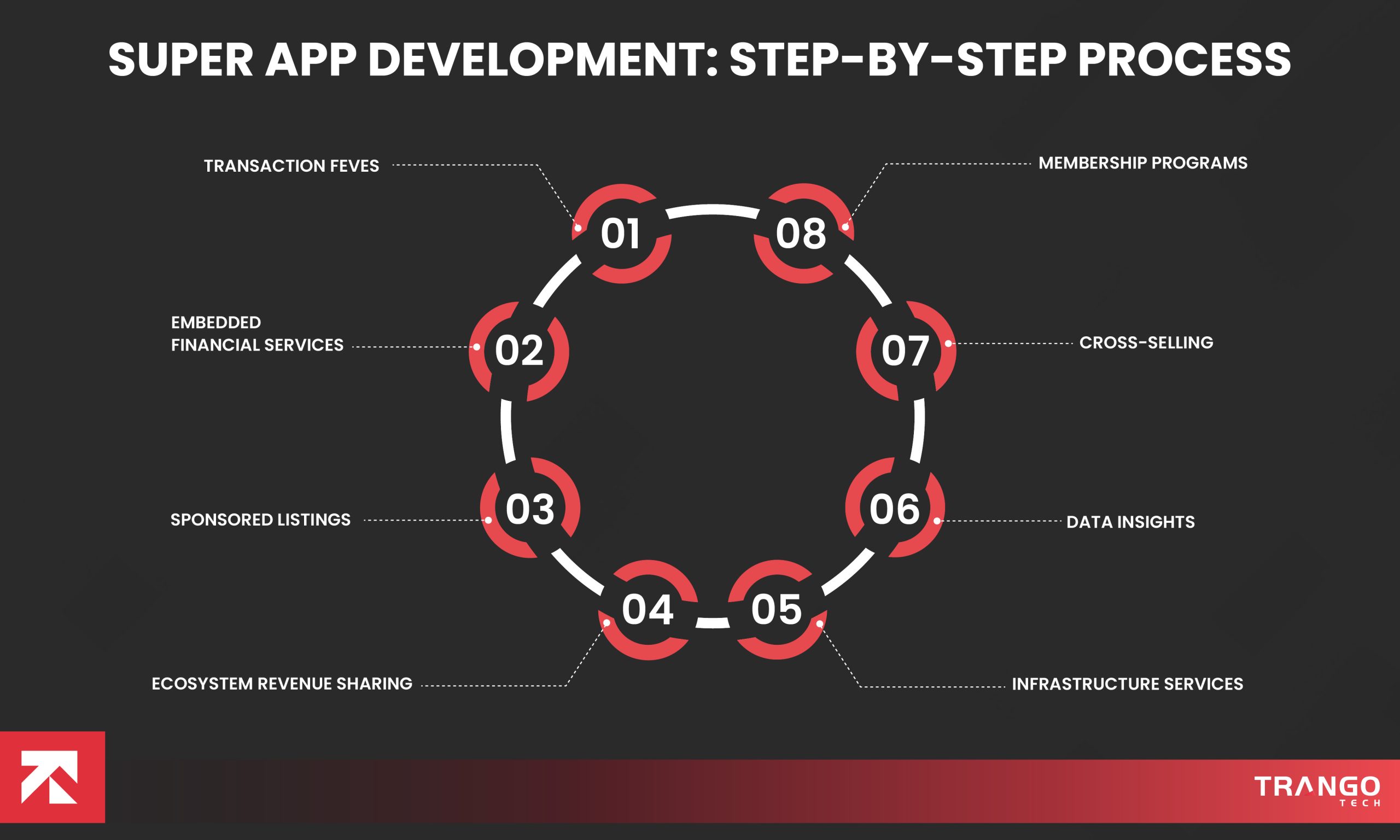
How Super Apps Make Money?
Unlike traditional apps that depend on a single monetization strategy, super apps generate income from multiple verticals.
It reduces financial risk, increases customer lifetime value, and builds long-term business sustainability.
See how exactly super apps make money and what makes their model so powerful.
Transaction Fees
The basic unit of a super-app is the transaction-fee model. Whenever the user rides, orders food, pays a bill, or even transfers some money, the app pulls out a small fee from the transaction.
Even though the charge might not seem significant on a case-by-case basis, the cumulative effect of millions of daily exchanges quickly converts it into a reliable and uninterrupted revenue stream.
The latter model is specifically efficient since super-apps promote the use on a daily basis; the portion of income is made out of every single transaction, producing a steady stream of income.
Embedded Financial Services
Most super apps go beyond the convenience features and include financial applications directly inside the application. These products may be in the form of digital wallets, peer-to-peer payments, micro-loans, insurance, investment options, or buy now, pay later.
These types of financial services typically fetch more profitability than traditional delivery or ride services and create user stickiness.
By having users rely on the application to pay and bank, the users are less likely to leave the platform, thus transforming a convenient app into a strong revenue-generating platform.
Sponsored Listings
The large number of users that super-apps generate is an appealing advertisement medium.
These platforms can charge premium rates in order to be seen by sponsored products, in-app banners, promoted merchants, or offered by location.
The success of this model lies in the richness of user data gathered, which is behavioural information, preferences, purchase history, and can be targeted to do advertising of very specific products.
Advertisements thus appear in the form of an automatic suggestion to the users, boosting the conversion rates and earning the platform a profit.
Ecosystem Revenue Sharing
A large majority of super-apps contain an open ecosystem to third-party developers and allow mini-apps to run on top of the full platform.
The super-app does not have to build all its services itself but runs the applications of outside businesses, receiving a portion of the fees they earn when making transactions or, as an alternative, asking for integration fees.
It is a win-win situation: the platform is not obliged to develop internally, and third-party businesses will get access to millions of users.
Or it can be compared with the idea of owning a digital mall, where every mini-app is a store that will pay rent and give part of its sales to the host.
Membership Programs
Subscriptions or premium memberships are an additional source of revenue for super-apps.
The customers will pay a recurring fee to enjoy such benefits as free delivery or expedited delivery service, cashbacks, exclusive offers, or priority services.
The fact that a small percentage of users subscribe creates an automatic and repetitive revenue.
Loyalty is also developed as a result of membership programs, whereby the users feel appreciated to stay within the ecosystem, thus enhancing long-term engagement and retention.
Cross-Selling
Super-apps have a deep understanding of the interaction between the user and the services provided, which makes it possible to cross-sell intelligently.
An example of this is when a user books a flight, the application could suggest travel insurance or a taxi to the airport, or when a particular user regularly orders food, a meal subscription could be offered.
Contextual and personalised suggestions increase expenditure and maintain convenience. As opposed to the traditional applications, which can make money in only one domain, super-apps generate revenue from all interactions in several categories.
Data Insights
The amount of information that is gathered by super-apps is large, including spending patterns, traveling habits, shopping patterns, using services, and so on.
Although privacy laws limit the direct selling of personal information, anonymised insights are of great usefulness to businesses.
Super-apps can provide merchants, advertisers, or partners with analytics services and help them make informed decisions.
As an example, a restaurant can find the most active ordering times, or a retailer can find out which product is in fashion. Information is therefore a strategic revenue resource as opposed to a result of usage.
Infrastructure Services
Lastly, there are certain super-apps that are monetizing their infrastructure and technology. They provide SDKs, API, payment, logistics, and identity validation, among other important services.
Third-party enterprises can afford to use these services, which makes the super-app a platform-as-a-service provider.
The revenue generation model does not depend on the interactions of the user but is a digital platform to fuel other companies, and also makes money by selling its technical services.
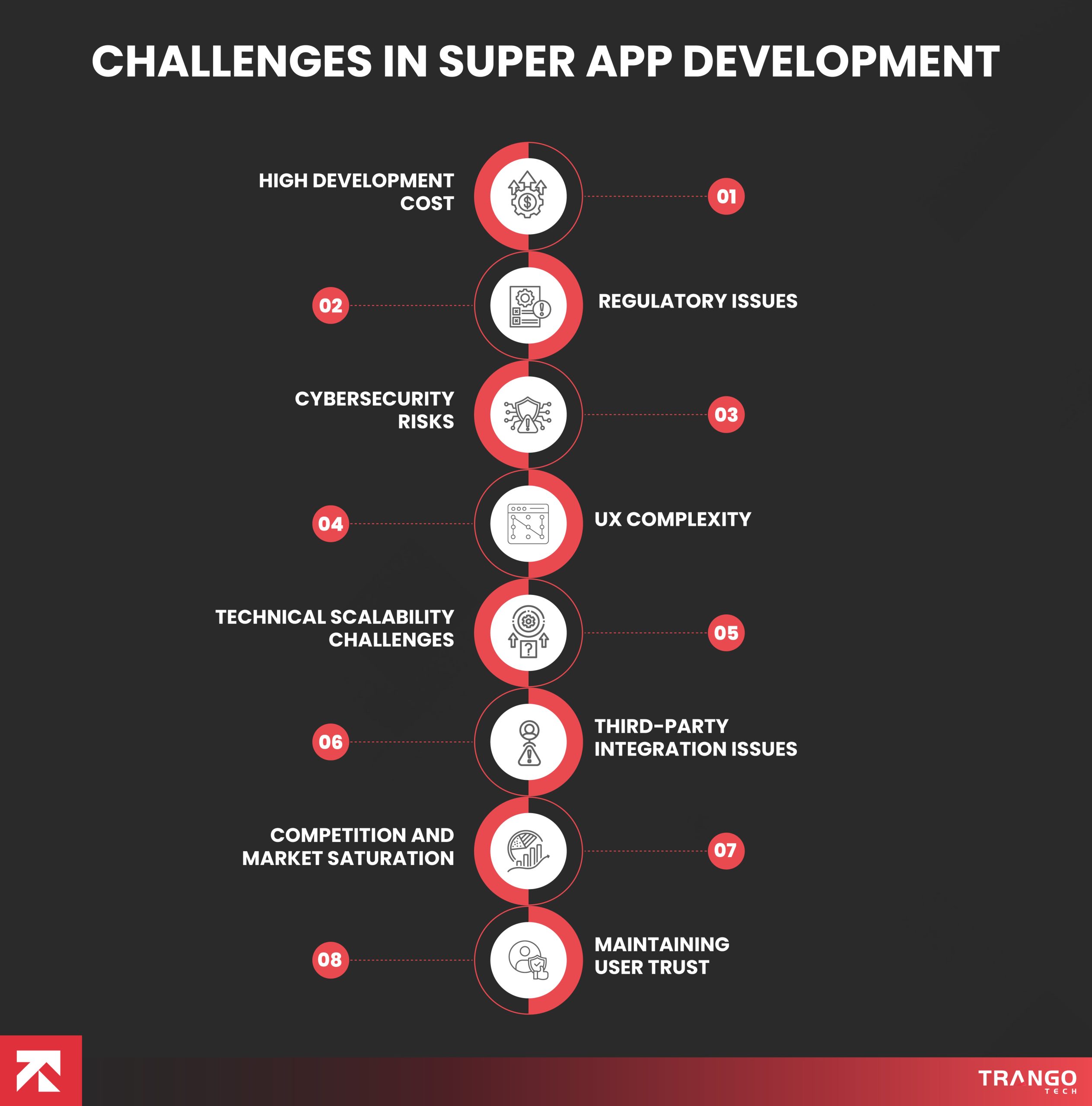
Challenges in Super App Development
Super app development has completely transformed digital business models. Yet building one is far from simple; it involves a fair share of challenges.
This is because you have to combine multiple services into a single unified app. It takes double the effort and hours for development.
Besides that, here are a few unique challenges that you should navigate thoroughly:
1. High Development Cost
To develop a super app, it should have a strong and scalable architecture, which requires considerable expenses in technology, talent, and infrastructure. A super app requires microservices, cloud infrastructure, integrated payment systems, and constant updates, unlike the traditional app, where only one service is concerned. Such complexity can easily push the cost of development to an unprecedented high value for any standard app project.
2. Regulatory Issues
Super apps frequently combine financial services, online payments, and personalization based on data, a factor that raises intense regulatory scrutiny. Financial, privacy, and consumer laws differ between nations, and non-compliance may lead to fines, service suspension, or even prohibition. To avoid this complicated environment, companies should actively collaborate with legal and compliance teams.
3. Cybersecurity Risks
Having several services under one roof, there is a threat of security attacks. Digital wallets, messaging systems, and other modules introduce a potential attack surface. The safety of transactions and data and their protection, as well as third-party integration safety, becomes an ongoing challenge that must be addressed through a high level of encryption, surveillance, and threat detection.
4. UX Complexity
A key issue is to make the user experience as straightforward as possible, even though the app is rather complex. The multi-service approach can be easily confusing to the user without an intuitive navigation, design, or interaction. Super apps have to be functional and usable at the same time so that the users are able to smoothly navigate all the services without the frustrations of using an app that does not fit.
5. Technical Scalability Challenges
The technical pressures on infrastructure when a super app is growing are increasing exponentially. The large and multifaceted number of users handling various functions at the same time, including payments, messaging, and ordering services, necessitates a strongly optimized backend. Efficiency in scalability without bringing the system to a halt is a big challenge to developers.
6. Third-Party Integration Issues
Mini-apps or external services are often used as a foundation of super apps. It can be complex to coordinate APIs, sustain a uniform performance, and ensure easy integration. Any interference by a third-party service would have a direct impact on the user experience.
7. Competition and Market Saturation
The market of super apps is hard to enter. Most of the areas already have the biggest players, such as WeChat, Grab, or Gojek, so it is not easy for new apps to develop momentum. In order to survive and develop, differentiation and a powerful market strategy are important.
8. Maintaining User Trust
Super apps handle sensitive data like financial transactions, personal messaging, and shopping behavior. Any privacy breaches, service failures, or misuse of data can quickly erode trust. Companies must prioritize transparency, data security, and customer support to maintain a loyal user base.
Build Your Own Super App with Trango Tech!
Super apps have made a structural shift in how businesses build, scale, and monetize digital products.
Likewise, the consumer interest is now diverted to apps that understand needs, predict behavior, and deliver value instantly.
That’s exactly what super apps are designed to do. Rather than a separate app, you get a unified platform that does everything you want.
However, building a super app requires ambition, skills, expertise, and the right development partner at your back.
Without the right app development company, the complexity will quickly become overwhelming.
If you’re planning to build a super app or transform your existing one into a multi-service ecosystem, hire Trango Tech.
Got an app super idea but don’t know where to start?
We help businesses turn ideas into high-performing super apps.
Frequently Asked Questions
1. How much does it cost to build a super app?
You should expect anywhere from $150,000 and $500,000+ to build a comprehensive super app. It may go up or down based on different direct and indirect factors that impact development. For instance, your budget may vary depending on app complexity, integrations, and team location. Get an exact quote with our app development cost calculator now.
2. How is a super app different from a regular mobile app?
Unlike conventional apps, super apps merge different services into a unified ecosystem. No matter whether you want to book a ride, order food, or pay a bill at the last minute, the super app has got you covered. The most interesting part of using such apps is that you don’t have to switch between different platforms.
3. Why are super apps so trendy?
Super apps are a hot topic because of convenience, less app clutter, and an impeccable UX. Businesses and users both get benefits from the need to use a separate app for each purpose. It also increases user engagement, collects valuable data, and generates lucrative revenue.
4. What industries can benefit most from super apps?
To be real, buisenss from nearly every industry can make the most out of super apps. The potential markets for this include fintech, healthcare, retail, logistics, travel, education, and entertainment. Yet the benefits of using super apps will be endless. You may utilize data for target marketing and increase user retention rates, potentially.
5. Are super apps secure?
Yes, if executed perfectly, super apps tend to be the most secure app category. Developers utilize advanced encryption and cybersecurity protocols to leave no margin for error. However, we recommend prioritizing security from different aspects.
6. What tech stack is used for super app development?
Based on our experts, we mainly use technologies like Flutter, React Native, Node.js, microservices, and Kubernetes. To ensure a flawless purpose for the super app, we use cloud platforms (AWS, Azure, Google Cloud). Other than that, if required, AI technology is also integrated.
7. Why should businesses consider building a super app now?
Super apps offer countless benefits for users and businesses alike. Those who invest early in this capture customer loyalty, diversify revenue streams, and set a USP. If you are still waiting to build one, remember you might be left behind. So now is the right time to start. Hire Trango Tech now to build an outstanding super app.
Daniyal is a passionate content writer & editor with 3+ years of experience crafting SEO-friendly blogs, web copies, and marketing content for an mobile app development company. He loves turning ideas into words that connect, engage, and deliver value. Currently working as a Senior Content Writer at Trango Tech, Daniyal holds a bachelor's degree in English Language and Literature.