Remember the frustration the last time you had to wait at the branch? With banking apps, that’s a thing of the past.
What once required long queues, paperwork, and limited hours now happens in seconds through banking apps.
As a matter of fact, around 60% of bank customers prefer digital-first interaction, yet many financial businesses still lack it.
Regardless of whether you check your quick balance or do a QR scan at your favourite place, a reliable banking app does it all.
Likewise, a business mobile banking application acts as a unique touchpoint between itself and customers.
At our fintech development firm, we’ve guided over 240 startups and institutions through their digital transformations.
This end-to-end guide leverages those experiences to help you build a world-class mobile banking application.
Want to develop a splendid mobile banking application?
Partner with our seasoned banking app developers to get help you.
Table Of Contents
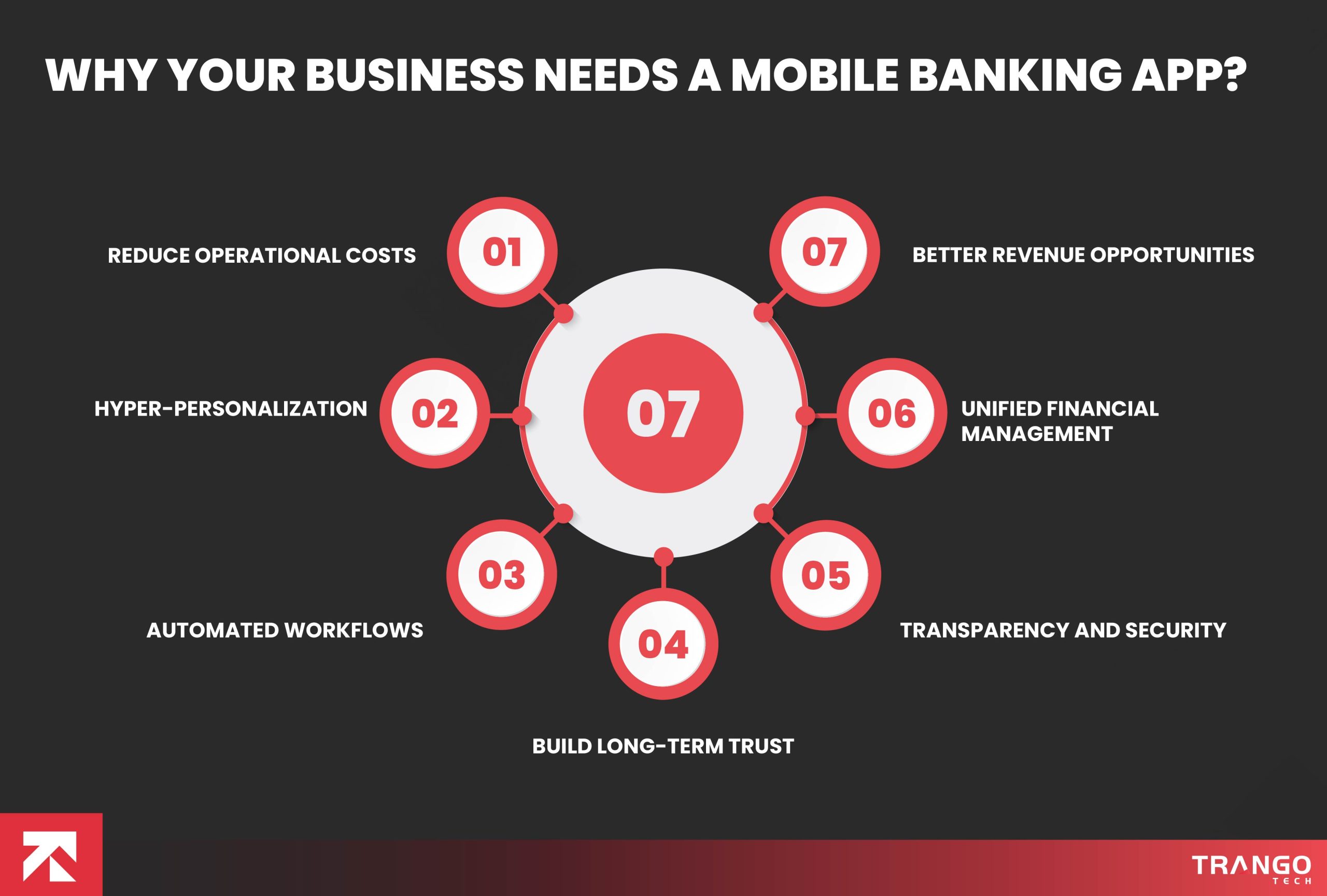
Why Your Business Needs a Mobile Banking App?
Customer behavior related to banking has changed to a large extent. They now hate visiting branches and calling support.
According to the American Bankers Association, a significant percentage, around 55% of customers, now love doing mobile banking.
Given that, if you, as a bank or fintech business, still rely on conventional practices, you risk being left behind.
Moreover, having an app is not enough. Your app should support instant transfers, airtight security, and an effortless experience.
Even more, sometimes users choose a bank based on how its app performs. Here is how an impeccable banking app helps you:
Reduce Operational Costs
Hyper-Personalization
Automated Workflows
Build Long-Term Trust
Transparency and Security
Unified Financial Management
Better Revenue Opportunities
It is essential to acknowledge that having an outdated banking app can backfire. You might lose loyal customers, and worse, they switch to rivals. So no matter whether you got a new app or are working on an existing one, just ensure it is up to the mark.
Types of Mobile Banking Apps You Can Go For
Before you start banking application development, it is paramount to know the different types of apps along with their purpose.
Mobile banking apps generally fall into several key categories, each seeking a unique set of features.
The right choice may vary from bank to bank, depending on the exact purpose they want to serve through it.
1. Full Service Applications
These are all-in-one mobile banking apps that support every financial task. You may use it for everyday tasks, check deposits, pay bills, transfer funds, and everything in between. Chase, Wells Fargo, and Capital One are a few of its famous examples.
2. Digital-Only Apps
These apps operate without physical branches. You don’t need to open a complete physical branch for this purpose. Investors with sound financial knowledge can easily make the most out of it. Varo and Chime are two real-world apps that fall under this category.
3. eWallet Apps
eWallet apps are primarily built for a small purpose. They come along with features like peer-to-peer payments, QR code transactions, and transfer history. Google Wallet, Apple Pay, PayPal, and Venmo are its popular examples.
4. Credit Union Apps
Credit Union apps provide 24/7 access to banking services. You may use it to check your balance, transfer funds, and pay bills swiftly. Unlike others, they are typically free and available on both the App Store and Google Play.
5. Finance Management Apps
These apps use AI in order to analyze your spending. Other than that, you get a budgeting tool to better control your financial life, along with advice. Monarch, YNAB, and Rocket Money are some of the best PFM apps you should consider.
6. Peer-to-Peer Banking Apps
P2P banking apps let individuals share fast, secure money transfers with each other. Such an app basically replaces cash or checks for different ritual purposes. Leading platforms like Zelle, PayPal, and Apple Cash are excellent examples of this.
Over 70% of users now prefer mobile banking over branch visits.
Trango Tech ensures your app is secure, scalable, and intuitive.
How to Create a Mobile Banking App?
Regardless of whether you are a bank or a banker, having your own mobile could be the reason you are left behind.
Since in digital banking, everything from a quick transfer to pay a bill at the last minute is done through an app.
To help you get started with mobile application development for banking, we have shared an end-to-end process.
Just remember that one mistake here can cost you user confidence. At the same time, a flawless app is going to let your bank or fintech brand grow rapidly.
Step 1: Define Your Banking App Purpose
At the very beginning of mobile banking app development, you should have absolute clarity about the purpose.
You should know what you are building, who you are creating for, and what kind of app suits you.
Simply ask yourself a few questions like:
Are you building an app for a traditional bank or a digital-only neobank?
Will it serve individuals, businesses, or both?
Do you want to focus on payments, savings, loans, or all-in-one banking?
Those who spend time to understand purpose, target audience, and pain points, thats where half of the job is already done.
For example, an everyday user may need a different app from the corporate users. A normal user may be limited to a quick balance check.
In contrast, a corporate individual may need a bulk payment and financial reports. Thats how exactly a purpose varies from person to person.
Step 2: Understand the Compliance Requirements
As discussed earlier, financial mobile app development is a very sensitive niche. It operates under strict financial laws.
Ignoring them can result in heavy penalties and a shutdown even before you launch your app.
Your chosen banking app development company should be well familiar with existing banking laws.
Moreover, they should do deep research about data protection rules and the applicable financial standards.
If required, involve compliance experts in the process to ensure you are safe and adhere to necessary requirements.
To be precise, you will prevent any legal trouble through this. Moreover, it will build more confidence in users to trust you.
Step 3: Plan the Core Features Carefully
According to research, around 45% of apps mainly fail because they lack the features users want.
So rather than cramming everything into the first version of your financial app, target the most necessary ones first.
You later have plenty of time to evolve it based on user feedback. Account overview, fund transfer, and history are non-negotiable.
Remember to aim for a thoughtful set of features, not overwhelm users with unnecessary options.
Step 4: Design Your Banking App UI/UX
Your design plays a significant role in the success of your banking mobile app development.
A confusing interface raises doubts instantly about the security and reliability of your mobile application.
What you are supposed to do is guide users naturally, making every action feel effortless, no matter what.
The most crucial aspect of your design is that it should communicate very clearly about the security.
For instance, subtle cues like confirmation screens and error messages help keep users satisfied.
Step 5: Choose the Right Technology Stack
For mobile banking application development, the suitable set of technologies can make or break success.
It determines how fast, secure, and scalable your mobile banking app will be. Generally, you can either go for native or cross-platform.
Those who want maximum performance may go for native app development. In contrast, cross-platform frameworks are ideal for swift development and low cost.
Also, you need to make sure that your system can handle high traffic, secure transactions, and data storage.
Step 6: Implement Strong Security
Since users trust you with their finances, even a minor vulnerability on your end can have serious consequences.
You need to protect user data through encryption, secure authentication, and continuous monitoring.
For more security, you’d better go for multi-factor authentication and biometric logins to leave no room for compromise.
Our expert team for mobile banking app development generally recommends keeping app security testing ongoing.
You find potential areas of weakness before attackers do. Also, you, alongside fewer security breaches, build trust.
Step 7: Test Your App Thoroughly
You should test every aspect of your app thoroughly in terms of security, performance, and quality.
Unlike it, we recommend giving it a tough time in realistic conditions as well. See how it performs, is it what you expect?
Even a minor bug leads to user frustration and financial errors. The same goes for user experience as well.
Do you observe how users get in touch with your app? In this way, you can refine navigation and fix consuming flows.
Remember that end-to-end testing reduces the risk of negative reviews and support issues that go unaddressed.
Step 8: Continuously Improve the App
Building a bank is not limited to launching only. You need to refine it from time to time to come up with the best version.
With analytics tools, you will monitor performance, collect user feedback, and ensure system stability.
Based on that feedback, you will help users with regular updates in order to keep it secure and relevant.
Successful banking app development is about growing as the number of users grows and their needs change.
Got an app idea but don’t know how to start?
Our banking app developers can help you with it.
Core Features Every Mobile Banking App Needs
Unlike conventional financing, mobile banking applications have gone beyond balance checks or funds transfer.
Modern clients prefer apps that respond quickly and protect their money without flaws. Those who achieve this will likely stand out.
Just remember that whatever features you add should focus on security, convenience, and better workflows.
Here are some unique features every mobile banking app should have:
Feature
Purpose
Secure registration
Ensures safe access to the app
Biometric authentication
Provides fast and secure login
Account overview
Displays real-time account balances
Transaction history
Shows detailed records of all transactions
Fund transfers
Allows quick and secure money transfers
Scheduled payments
Automates recurring and future payments
Card management
Users will freeze cards, set limits, and create virtual cards
Savings management
Assists users in building and achieving savings goals
Instant alerts
Identifies suspicious activity in real time
How Much Does Mobile Banking App Development Cost?
The development of a banking app can cost you anywhere between $30,000 to $300,000, usually.
Your actual project cost will depend on the features, team location, and integrations in the app product.
Though it may seem pricey, when done right, it builds trust, loyalty, and reliability that is worth it.
Every single decision during development, like design changes to the right set of technologies, impacts it.
Basic mobile banking app: $40,000 – $70,000
Mid-level banking app: $70,000 – $150,000
Advanced banking app: $150,000 – $300,000+
Since banking is a quite sensitive niche, these numbers may not be final. If you require advanced security features for AI-powered integrations, it may change slightly.
You can optimize the cost associated with the development of mobile banking simply through a few effective tactics.
Start with an MVP, make use of cross-platform frameworks, and hire a potential partner in this regard.
Want an exact quote for banking app development?
Use our app development cost calculator for a fixed quote.
Benefits of Building Your Own Banking Application
Modern users want instant access to their finances, regardless of time, anywhere, and on any device.
Apart from checking the quick balance, paying a bill, or applying for a loan, they seek a reliable banking app.
Also, for you, relying solely on others’ systems no longer seems feasible. You need your own banking application.
While the users enjoy convenient control over their finances, at the same time, banks gain efficiency, insights, and revenue opportunities.
If you are a bank or a regular user still without a fintech application, here is what you are missing out on:
For Users
Unmatched Convenience
A banking app allows users to manage their finances around the clock. They want to effortlessly check balance, send money, and track transactions. That too, without visiting branches or standing in endless queues.
P2P Payments
With just a few taps, banking app users can complete payments, transfer funds, and make account updates. In this way, such apps eliminate paperwork and reduce transaction time. You let users enjoy quick and stress-free banking.
Enhanced Security
Modern banking applications put into teh use very stringent security measures. Unlike conventional ones, they have biometric, encryption, and 2FA verification. With that, your app users will enjoy extra security and safe transactions.
Personalize Experience
Banking apps let you analyze user data in terms of spending patterns and favorite activities. You receive valuable feedback and tweak your services based on it. In this way, users receive solutions that meet their needs.
Real-time Notification
If you offered a discount on the most-loved place, and your customer gets a quick alert about it? Isn’t that intriguing? That’s exactly what makes banking apps a handy way to connect users. They get to know about everything every time.
Financial Awareness
Many of the banking apps come with very useful features to help you keep track of your expenses. You can track expenses, get spending summaries, and use budgeting tools to do so. These features may look helpful, but are variably admired by Gen Z and millennials.
Regular Rewards
As a part of customer appreciation, most of the banks offer outstanding rewards. Users enjoy discounts, cashbacks, and interactive gaming features. The goal is simply to encourage better saving habits and to persuade them to come back.
For Banks
Significant Cost Reduction
Banking apps automate most of your operational tasks, like cash deposits and bill payments. You don’t have to rely solely on physical branches, so there’s no need for large staff, infrastructure, or administration. It ultimately leads to low ongoing costs.
Bettean innovativemer Retention
With push notifications, in-app messages, and digital support, your bank can maintain better retention rates. It can be an innovative yet very effective way to increase loyalty and retention rate.
Superior Value Proposition
A feature-rich banking application will become a kind of USP for your banking reputation. No matter whether you are a fintech startup or a digital-first bank, without an app, you risk being left behind.
Lucrative Opportunities
Relying solely on your core services is no longer enough. With your own banking app, you can also cross-sell and upsell multiple services. For instance, you can provide quick loans, insurance, and investment products directly within the app.
Valuable Data Insights
Banks can analyze user interaction and transaction data to come up with unique insights. They observe customer behavior and suggest a relevant choice. In this way, they are gonna improve services and manage risk early.
Improved Brand Image
Banks with their own apps directly hit users’ minds. They consider you the most reliable and convenient to go for. Simply put, you grow brand reposition and build trust among modern users.
Broadened Reach
Mobile applications will allow your bank to target a wide range of users. You extend footprint for 2 billion-plus online users. Also, this reach is not limited to mobile only. Users across browsers and devices can find you.
Technologies You Can Utilize for Banking Application Development
Since banking is quite a sensitive niche, the mobile apps here are built on a powerful set of technologies.
Industry studies show that only 30% of banking digital transformation programs have reported complete success.
When you use high technologies, you get smooth performance, protect sensitive data, and ultimately have no technical debt.
Remember that the success of your banking mobile app development depends on the reliability of the technology you use.
Having a well-planned tech stack will improve your performance, strengthen security, and make innovation easier.
Those who invest in sustainable technology for now will position themself for a better tomorrow.
Challenges in Mobile Banking Application Development
Banking app development involves a fair share of challenges that can be more complex.
Due to strict regulations, high security expectations, and complex integrations, building a banking app has become far more complicated.
Even a minor mistake often leads a business to a data breach, financial loss, or loss of customers’ trust.
Below are the key challenges associated with mobile banking app development:
1. Sophisticated Digital Threats
When building a banking app, you may need to tackle advanced threats like phishing, deepfakes, and API attacks.
As a matter of fact, apps in the financial category have 300% of more likely targets than other industries.
In order to survive and supersede others, you need strong encryption, secure APIs, and regular security audits.
Moreover, your app should be sufficiently robust to protect against data breaches, malware, and man-in-the-middle attacks.
Though most businesses have already implemented such a message, they have fallen short in addressing advanced cyber threats.
2. Legacy System Integration
Most of the banks and institutions still rely on legacy systems that were years, maybe even decades, ago. Yet
For experts in mobile banking app development, integrating your app with a legacy system is a great challenge.
You will have to connect modern, agile mobile front ends to older, rigid, and complex backend systems.
If not done well, it may backfire in the form of low technical debt, high maintenance, and data incompatibility.
A practical yet difficult approach to working with a modernized banking app development approach is a better choice.
3. Performance Bottlenecks
High-performance features may fail or lag on older devices, which leads to user frustration. You can’t afford it.
No matter the time of day, users want mobile baking applications to work very efficiently during peak hours.
You should look for issues like performance inconsistencies, UI/UX disruptions, and vulnerabilities in a timely manner.
Moreover, developers should prioritize the use of cloud infrastructure, load balancing, and scalable architectures.
4. High Development Cost
Not necessarily true, but mobile banking apps are pricey and unaffordable for those with a limited budget.
Moreover, the expanse of creating and updating a native app for multiple platforms can cost you a fortune.
You have to maintain high security standards, incorporate new technologies, and keep up with the latest trends.
All these require an increase in the cost associated with mobile banking application development.
The best thing is that the banking apps are entirely free for users, and they don’t have to pay a penny.
5. User Experience vs. Security Balance
This is the most challenging yet most overlooked aspect in mobile application development.
You have to make sure the app is fast and easy to use. Meanwhile, it should have very stringent security.
This is kinda constant challenge to balance them without impacting the ease of use in your application.
Too many security steps will frustrate users, while too few can expose the mobile application to risks.
6. Cross-Platform Compatibility
You have to affirm that the banking app has consistent performance on a wide range of iOS and Android devices.
Moreover, if required, it should run flawlessly on multiple devices, operating systems, and screen sizes.
It adds another layer of complexity to your banking application development approach, which is way more challenging.
Other than that, testing your app across different devices and platforms may require additional time and resources.
7. Regulatory Compliance
Your bank has to comply with strict financial and data protection laws, which is quite hard to deal with.
Interestingly, such laws vary from country to country. What works in Dubai may not work in the USA.
For instance, you may have to adhere to GDPR for data privacy, PCI DSS for secure payments, KYC, and AML.
Those who fail to comply with these standards will risk facing heavy fines and legal issues later.
You’d better direct your development team to go the extra mile in order to adhere to existing laws in the target region.
8. System Lifecycle Management
Do you think that your banking app development journey is finished once your app hits the market? You’d be half right.
The real challenge begins right after that. You need to update your app over time to keep it market-relevant.
For this purpose, you may add meticulousness to improve performance and comply with existing regulations.
More than that, it requires a long-term effort, skilled teams, and a meticulous rollout in the market in this regard.
Still struggling to create your own banking app?
Trango Tech knows what works for it and what does not.
Why Should You Hire Trango Tech for Mobile Banking App Development?
The right banking mobile application development partner can make or break your success.
At Trango Tech, we understand the fintech niche and your needs like no one else. With hands-on experience in digital banking, we know who is who and what is what.
More than that, our developers have helped 240+ clients shape success stories. Altas, Money Wave, and Kitty Appare just a few of them.
Each of these projects portrays our deep understanding of financial workflows, secure transactions, and user expectations.
Below are several other benefits of hiring us:
Security-First Development
Advanced Fraud Prevention
Open Banking Integration
Transparent Communication
Custom-Built Solutions
Rigorous Quality Assurance
Besides all that, what truly sets us apart from other banking app development companies is the quality of our work.
It doesn’t concern us if you are a newbie bank or a Fintech bigwig; we provide premium development services.
Still got doubts? Check out our very recent project testimonial by Sophia Lemoglia and how she felt with Trango Tech.
Hope this summary of her points on Trango Tech was worth listening to. In fact, everything from project management to creative execution, we went the extra mile to fulfil her requirements.
Build Your Own Banking App with Trango Tech!
Mobile banking app development has gone far beyond just creating a digital version of traditional banking.
Users want all their financial services, whether it be funds transfer, bill payment, insurance, or whatever is required, in a single app.
To meet these expectations, banks as well as financial institutions are eager to invest in banking applications.
However, building a secure and scalable banking app is not something you should rush or take lightly.
It requires a solid understanding of the fintech industry, compliance expertise, and a reliable team to code.
If you have an app idea for banking that you believe could be the next big thing, pitch it to Trango Tech.
50% of apps fail due to weak planning and execution.
Trango Tech ensures your mobile banking app is reliable, secure, and fast.
Frequently Asked Questions
How long does it take to develop a mobile banking app?
Based on our experience, it takes around 3 to 18 months to develop a fully functioning app. The real development timeline may vary based on factors like app complexity, feature set, and team size. If you want to know precisely how long your project might take, get in touch with our experts. They will understand your idea, scope, and needs in order to come up with a very precise duration.
How much will it cost to create a banking app in 2026?
For banking mobile app development in 2026, you should expect to pay between $30,000 and $400,000. It may still fluctuate with factors such as app complexity, approach, and regional hourly rates. For an exact quote, we recommend using our app development cost calculator now.
What are the paramount security features that your banking app should include?
Modern banking users expect you to provide more than just normal functionality. They want you to deliver what matters most to them. For instance, biometric authentication, end-to-end encryption, and secure APIs are non-negotiable. To further enhance the security of your app, you should leverage AI technology. It makes fraud detection more effective and works best for user identification.
Is security compliance mandatory for banking apps?
Undoubtedly, compliance with existing data laws is very important. Those who don’t prioritize it later risk themselves in the worst-case scenario. It may backfire in the form of heavy penalties or may be a legal action. Remember that such laws vary from country to country. Generally, you should adhere to DSS, GDPR, PSD2, and local banking laws.
Can you integrate AI into a mobile banking application?
Yes, of course. More than good, you will set your app miles apart from where competitors stand. The use of artificial intelligence helps you detect sophisticated fraud very early and keep a check on user spending. Other than that, based on that specific data, you can personalize your services. Last but not least, Chatbots are one of the most favourable uses of AI.
How can you choose the right banking app development company?
It is pretty challenging to choose the best app development partner among thousands of available options. The best thing is that there are a few traits you should look into to finalize any name. First of all, look for someone with proven experience in the fintech niche who has already been a part of a project like yours. Moreover, ask them about how they prioritize app security and their development approach. In the end, if you need more clarity, firm up with their previous clients for satisfaction.
What makes Trango Tech stand out for mobile banking app development?
To be real, our firm commitment to quality and excellence is a quality that sets us apart from others. We know technical things, state-of-the-art technologies, and have the same extensive knowledge of the industry. As of now, we have helped around 240+ financial institutions, banks, and startups, and can do the same for you.
Daniyal is a passionate content writer & editor with 3+ years of experience crafting SEO-friendly blogs, web copies, and marketing content for an mobile app development company. He loves turning ideas into words that connect, engage, and deliver value. Currently working as a Senior Content Writer at Trango Tech, Daniyal holds a bachelor's degree in English Language and Literature.