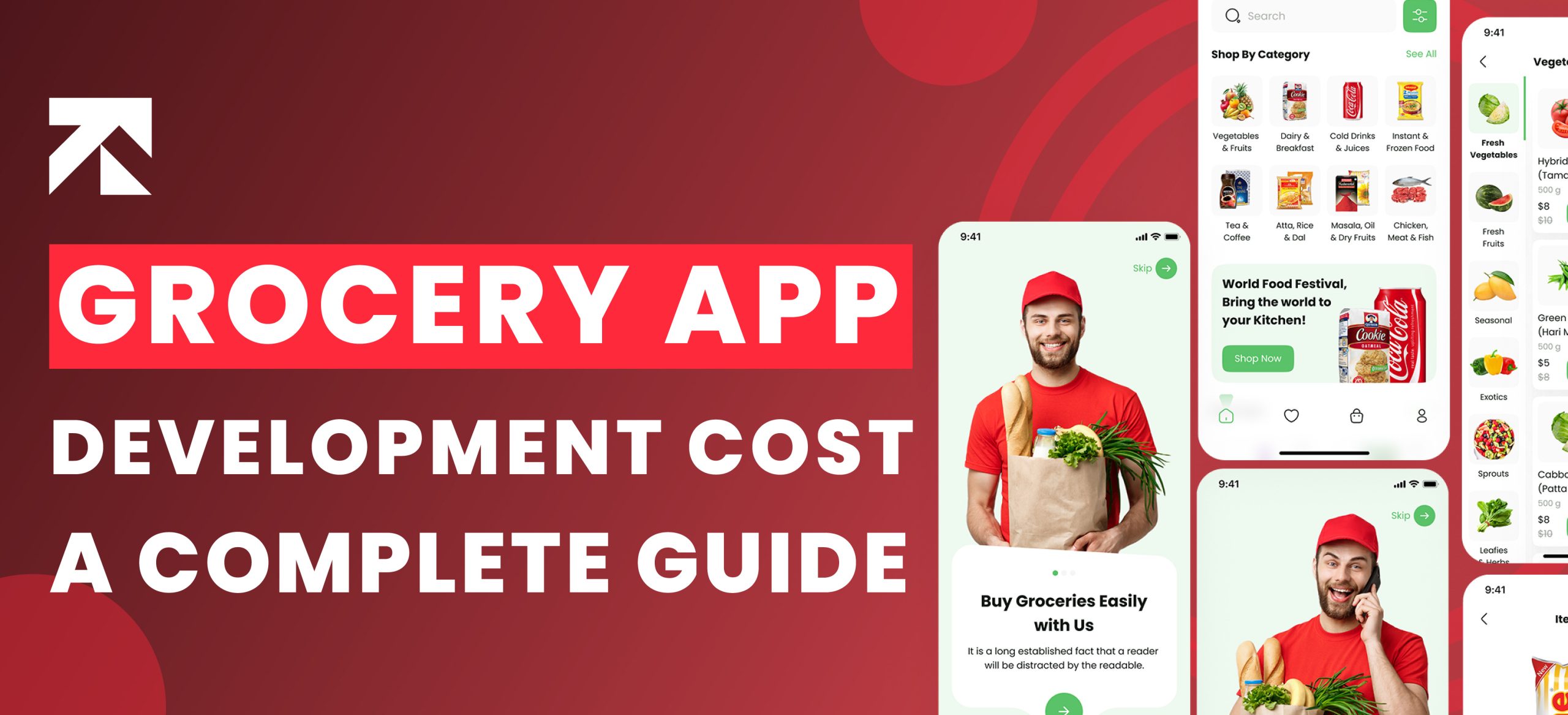
From the day the COVID-19 pandemic hit the world, our lives have changed 360 degrees. And since then, one of the most significant changes in our lives has been the shift in grocery shopping. Rather than visiting the grocery store, you can now have everything delivered to your doorstep with your smartphone.
Just a few simple taps on your favorite online grocery store, and after a few minutes, it reaches your home. What else do you want?
According to Statista, in the US alone, online grocery revenue is expected to reach the 455 billion dollar threshold by 2029.
This shows a complete transformation of the market, as more and more people now prefer same-day delivery and personalized offers.
And this shift has opened the doors of opportunity for startups and retailers looking to enter this market and make a profit. It’s also a great time for physical grocery stores to create their online grocery app as well.
But this is not a one-size-fits-all approach, and a well-planned app defines the budget of your app. So, before entering the market, one must know the cost of grocery app development.
In this guide, we’ll walk you through the grocery app development cost and factors affecting the cost as well.
Table Of Contents
How Much Does It Cost to Build a Grocery Delivery App?
The grocery delivery app development cost is not fixed as it depends on multiple factors, such as features and functionality.
However, here’s a realistic grocery delivery app development cost breakdown depending on the project’s complexity.
1. Basic Grocery App: 40,000$ – 100,000$
A basic version of a grocery app is suitable for startups. This model has essential e-commerce functionality without advanced-level automation.
This model supports basic features like user registration, product listing, secure payment integration, order tracking, and an admin panel.
2. Mid-Level Grocery App: $100,000- $200,000
These types of grocery apps include support for multiple vendors, delivery partner management, complex search filters, and real-time inventory updates. It also includes features like push notifications, discount engines, and a better analytics dashboard.
It’s suitable for growing businesses, but it needs strong backend architecture and cloud integration.
But remember that this level of grocery app increases the cost because the system has to support multiple user roles, real-time logistics tracking, and supplier coordination. Most of the regional and competing local platforms fall under this category.
3. Advanced-Level Grocery Apps: $200,000 to $400,000
A grocery delivery app development like Instacart costs even more. It is integrated with features like AI recommendations, voice search, and multistore support as well.
It also offers a dashboard for multiple suppliers, commission management, and subscription billing. It provides advanced-level data analysis and forecasts, helping businesses to make more informed decisions.
4. Enterprise Level Grocery Apps: $400,000 to $600,000
If you’re looking for enterprise level grocery, then it may range between $400,000 to $600,000. This level of grocery apps integrates features such as AI & AR, multi-region support, and IoT integration.
Factors Affecting the Grocery Delivery App Development Cost
No doubt the project’s complexity level is a key factor that determines the cost, but there are other factors as well that impact the overall cost of the grocery delivery app development.
1. Functional Complexities
The more complex the features of the app, the more costly the app will be. Advanced apps include features such as smart route optimization, AI-based product recommendations, loyalty programs, member administration, and a dashboard for multiple suppliers.
2. Choice of Platform
Your choice of the platform (Android, iOS, or both) also affects the cost of grocery app development.
Separate native apps are slightly costlier but give better performance, whereas a cross-platform solution has a low cost but less optimized UX. Platform choice also impacts development time, testing, and development cost.
3. Backend Infrastructure
A strong backend infrastructure is also a very important factor for real-time inventory management, delivery coordination, order tracking, and analytics. It means it needs cloud-based infrastructure, server setup, and database architecture that contribute to the cost of the grocery app development.
4. Third-Party Integration
Integrations like APIs for payment gateways, sms alerts, GPS tracking, and analytics come with a license and subscription fees.
But each integration means the complexity of the app increases, which in turn affects the overall cost of the grocery app development.
5. Design And User Experience
An intuitive interface also contributes to the design hours and adds to the cost as well. Let’s suppose you opt for the customized user interface, responsive designs for various screen sizes, and interactive product catalogs, which add up to the total cost.
6. AI And Automation
It’s 2026, and if you’re not leveraging AI in your grocery apps, then you’re behind. Today, AI is used for product recommendations, route optimization, predictive lists, and personal offers.
But infusing AI needs data collection, and many need cloud-based ML services that ultimately increase the cost.
Of course, the more brilliant the app, the more it costs to develop a grocery delivery app.
Top 3 Business Models Affecting Grocery App Development Cost
The model you choose for your grocery store affects both the cost and the preferred architecture.
1. Inventory-Based Model:
An inventory-based model means you own all the products yourself. You have to manage the warehouse yourself, collaborate with suppliers, handle inventory, and fulfill orders.
This needs supply chain integration and a warehouse management system, which also needs money.
2. Marketplace Model:
Marketplace model apps connect retailers with customers. It requires a strong multi-vendor management system that must not break down during the peak demand period. In this case, you’re an aggregator connecting customers with grocery stores.
It impacts cost heavily because it needs merchant dashboards and multi-vendor management features.
3. Hyper Local Aggregator model:
This app connects with local nearby stores and focuses on fast delivery within a limited geographical location.
This model depends on geolocation APIs, real-time updates, and a smart shipping algorithm. It needs investment in logistics technology and affects the overall cost of grocery app development.
Hidden Expenses that can Increase Grocery App Development Cost
The cost to develop a grocery delivery app gets expensive after initial development work. The hidden expenses are around 25-40% of the total first-year investment.
1. Continuous Maintenance & Updates
A well-functional app requires post-maintenance support like regular updates, bug fixes, feature improvements, and security patches. And all these post-maintenance factors need investment. It typically takes 15% to 20% of initial development per year.
2. Hosting Infrastructure
Cloud infrastructure begins at reasonable rates but gets costly quickly. Monthly hosting can cost around $500-$5,000.
It can even exceed $10,000 monthly for disaster recovery and an enterprise solution with high availability.
3. Marketing Investment
The most important part after building your application is to acquire customers, which is more costly than development.
Customer acquisition cost for grocery delivery ranges from $15 to $ 20 per user on average. Successful grocery applications invest an average of $500,000-$200,000 in initial marketing campaigns.
4. Legal & regulatory Compliance
Regulatory requirements vary depending on the location, but they are never cheap. It includes business licensing, data privacy compliance, food handling permits, and more, all of which add up to the cost quickly.
Ongoing compliance costs also make it expensive annually. Ignoring compliance means you have to face fines, operational shutdown, or even worse consequences.
Ways to Optimize On-Demand Grocery Delivery App Development Cost
Looking for ways to reduce the cost to develop a grocery delivery app without compromising on the product’s quality?
Have a look below at how successful businesses optimize their investment.
1. MVP Strategy:
Before launching the full-fledged app along with AI integrations, it’s better to launch a basic MVP version first. It allows you to test the market demand with reduced financial risks.
Your MVP should have
User registration and profile management,
product catalog and search,
Ordering and checkout process
Basic order tracking and status updates
Basic payment processing
2. Feature Selection:
Not every feature needs to be integrated instantly. Prioritize features by focusing on essential features with less complexity and then grow with time, including AI-integrated advanced features.
3. Cross-Platform Development:
You can save around 30-40% with cross-platform app development. It uses a single code base for ongoing maintenance, speeds up the development process, and also improves the user experience across multiple platforms. It also reduces the long-term maintenance cost.
4. Strategic Outsourcing:
Geographic outsourcing also has a direct impact on grocery mobile app development costs. It can heavily reduce the cost depending on your preferred outsourcing model.
Nearshore Development: Can reduce 30-40% cost with compatible time zones.
Offshore Development: it can cause a 50-70% cost reduction with few communication challenges.
Hybrid Team Structure: Hybrid Team Structure: It combines offshore development resources with local project management.
Conclusion
Wrapping up, now you must be aware of the grocery app development process in detail and also the factors that affect it. A basic grocery delivery app may range between 40,000$ to $100,000, while a more complex app may cost $200,000 to $400,000. But there are some hidden expenses as well, such as app maintenance, marketing costs, and hosting infrastructure. Hire an experienced grocery app development company and start your grocery delivery app journey.
Partner with Trango Tech for Grocery Delivery App Development
Analyzing the grocery delivery app development cost is extremely important before entering into this area. A well-calculated cost to develop a grocery delivery app allows you to align your budget with customer demands and market goals. Spend each dollar carefully as it must provide you with a value, such as improving the user experience, driving sales, and increasing revenue.
Partner with Trango Tech to get the best and most affordable grocery app development services. We have 10+ years of experience creating grocery delivery apps and delivering them on time. Don’t worry about the development cost of a grocery delivery app, as we make sure to offer the most affordable cost.
Talk to our experts and get an exact quote for your grocery app development.
Frequently Asked Questions
Q1. How long does it take to build a grocery app?
The basic app may take 3-4 months, while a more advanced app may take 4-6+ months to create. However, the grocery delivery app development timeline and cost depend on multiple factors like the number of features, complexity level, AI integration, level of customization, etc.
Q2. How to choose the right grocery app development company?
Consider the following steps before choosing the right grocery app development company.
Analyze their experience and expertise.
Verified customer reviews
Post-launch support and maintenance
Experience with custom grocery apps
Check their portfolio.
Q3. How can I keep development costs within my budget?
You should begin with MVP development to understand the market and customer demand. Prioritize essential features first, and go for cross-platform app development for cost efficiency. Work with an experienced team so you don’t have to pay extra for revisions.
You must plan beforehand for hidden costs like maintenance, hosting, and marketing.
Q4. How does AI boost the grocery app shopping experience?
AI improves customer experience as well as backend efficiency. AI integration gives personalized recommendations of products, optimizes search results, and tells frequently purchased products, improves demand forecasting, and reduces abandoned carts.
Q5. Can I monetize my grocery delivery app?
Yes, you can monetize your grocery delivery app through methods like delivery charges, subscription plans, premium listings, in-app ads, and affiliate partnerships.
Muhammad Asif is an experienced SEO expert at Trango Tech, a leading mobile app development company. With a strong background in software development and mobile technology, he specializes in optimizing digital presence for app-based businesses. His expertise in search engine optimization, content strategy, and technical SEO helps improve visibility and drive organic growth.
As a passionate tech writer, Muhammad regularly shares informative and insightful articles on mobile app development, emerging technologies, and digital marketing trends. His content empowers businesses and developers with the latest industry insights, ensuring they stay ahead in the competitive world of app development.