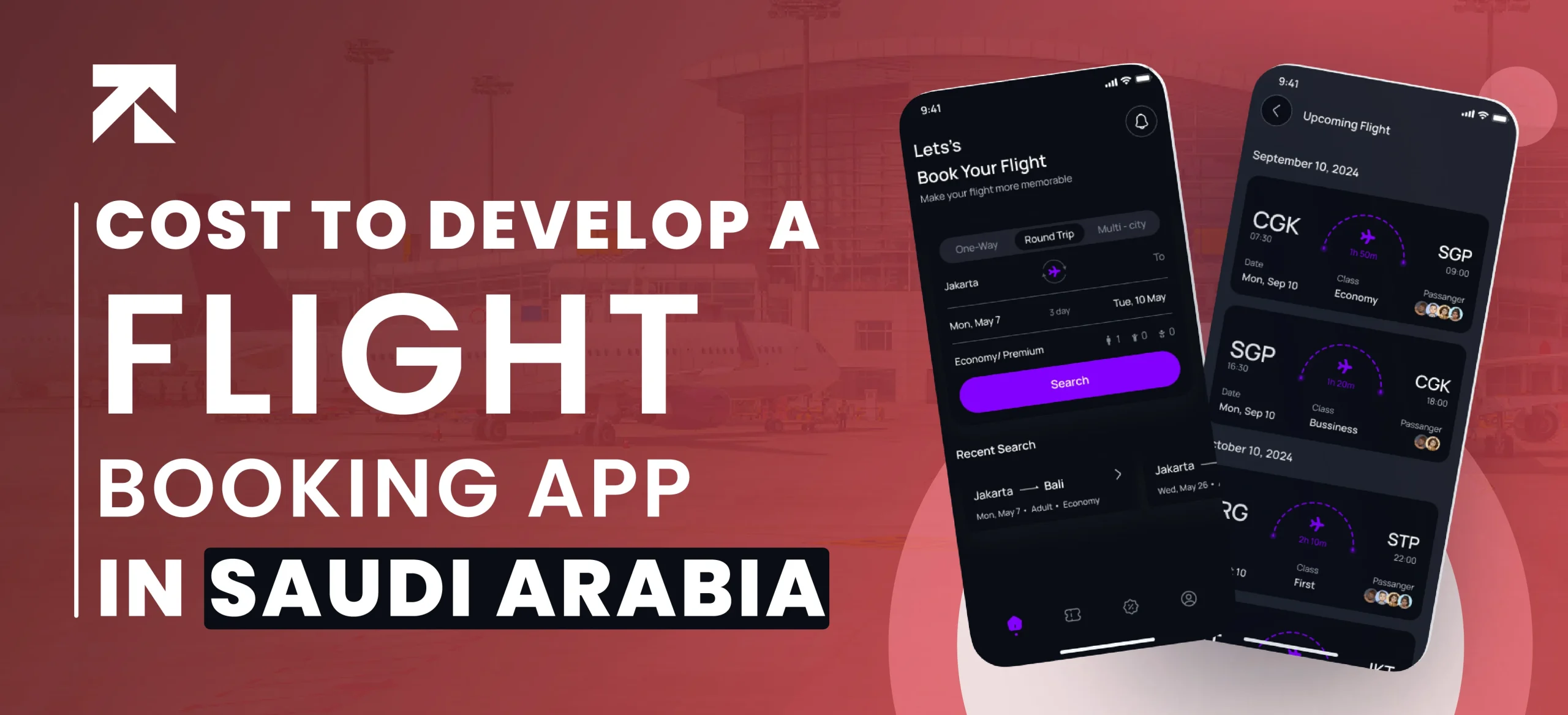
Generally, it takes around SAR 150,000 to SAR 1,000,000+ to build your own flight booking app in Saudi Arabia. It merely depends on your app complexity, integrations, and development strategy.
In fact, every minute, thousands of travelers search for flights, compare fares, and book tickets right from their apps. If you are looking to capture a slice of this multibillion-dollar travel tech market, try us for mobile application development in Saudi Arabia.
According to Ken Research, the current travel app development market in Saudi Arabia is booming, valued at $5 billion. The massive expansion of Riyadh Air, the growth of giga-projects like NEOM, and Vision 2030 drive it.
So before talking about numbers, you need to understand what actually drives development costs. This write-up breaks down every riyal, feature, and technical hurdle that impacts the cost of building a world-class flight booking app.
Table Of Contents
Flight Booking App Development Cost Quick Breakdown
While every project is unique, the current market rates in Saudi Arabia for travel app development typically fall into these three brackets:
App Complexity
Estimated Cost
Development Timeline
Basic (MVP)
SAR 80,000 – 150,000
3 – 4 Months
Mid-Level
SAR 180,000 – 350,000
5 – 8 Months
Complex
SAR 400,000 – 900,000+
9+ Months
Want to know the exact quote for your flight booking app idea?
Use our app development cost calculator for an exact cost estimate.
Factors That Influence the Cost of Developing a Flight Booking App in Saudi Arabia
When someone asks you about how much it costs to build a flight booking app, they are actually expecting a simple number. Yet the fact is, you can’t claim a direct number. Such apps are way more difficult than eCommerce or food delivery apps.
Through this, you have to connect airlines, process secure payments, and last but not least, come up with a bilingual experience. Considering all that, it becomes paramount to keep in check with different factors that affect the overall price bracket.
I will discuss each factors that influence the cost of developing a flight booking app in Saudi Arabia individually.
Keep reading for more.
1. App Complexity Level
The biggest yet challenge factor that amplifies your flight booking app development cost is the complexity of your app. A normal app with basic functionalities such as searching flights, selecting tickets, and making payments will naturally be budget-friendly.
In contrast, a mid-level app with advanced filters and active updates is a bit pricy. Since it requires an extra development time and backend complexity, expect a bit more. Besides that, for your very own fully functional app, you require a lot of resources. To handle high traffic volume, add multi-GDS integrations, AI-based pricing logic, and commission systems.
In the end, the more feature-rich you want, the longer it takes for development, and the higher the price will be.
2. Platform Choice (iOS, Android, or Both)
We find it more affordable initially to develop for iOS only or Android. However, businesses across KSA love to go for both platforms.
Simply put, those who build native apps for both iOS and Android have to create two separate applications. Though it benefits back in the form of maximum performance and platform-specific optimization, you should expect a high cost for custom flight booking app development.
Alternatively, cross-platform frameworks like Flutter or React Native let developers do it with one codebase for both platforms. Your app development cost will likely drop by 20–30%. The best practice here is to consider your budget, scalability plans, and long-term strategy as a way forward.
3. Flight API Integrations
Flight booking apps rely heavily on external aviation systems. Integrating with Amadeus, Sabre, or Travelport is paramount. Moreover, for those who want access to flight inventory, seat availability, and pricing, they will also require Global Distribution Systems.
However, GDS integrations are technically complex. It takes licensing agreements, certification processes, and service charges. To be precise, see the number of GDS systems you add up and expect the higher cost accordingly.
4. Payment Gateway Integration
To make your app extra trustworthy, you should have reliable payment options. When it comes to Saudi Arabia, Mada, credit/debit cards, and mobile wallets like Apple Pay are a few options you have.
Each and every payment gateway requires integration, compliance checks, and transaction security protocols. Besides that, it must comply with PCI-DSS standards that require some extra resources for development.
5. Backend Infrastructure
For a low-cost flight booking app, the front-end interface is just what you see. But in reality, there is always a powerful backend architecture supporting everything going on. For instance, the backend of your flight booking application in Saudi Arabia should:
Show updates fare
Booking confirmations
Process thousands of API calls
Store secure user data
Scale during peak seasons
Since you are planning to grow in GCC markets, remember that volumes are massive during Ramadan and Hajj seasons. In that case, advanced cloud infrastructure with load balancing, auto-scaling, and high-level security becomes a non-negotiable. Similarly, the more you move towards scalability, the higher the pricing will be.
6. Compliance with Local Regulations
Did you know that about 14.3% of apps are fully PCI-compliant? This sharp decline indicates a need for better data management. Following that stat, operating in Saudi Arabia requires you to remain strictly compliant with existing financial and data laws.
Payment security standards, Data protection laws, and Consumer protection policies can require you to put in extra hours. For better compliance, you also need a legal consultation, security audits, and additional technical safeguards.
This may look like a large investment at the start, but at the end of the day, you save yourself from heavy penalties.
7. Fraud Prevention Systems
Airlines lose an estimated 1.2% of their online revenue to payment fraud, making stringent security paramount. Since the flight booking process involves hefty payments, your app might be subject to fraud attempts and cyber threats.
To mitigate this risk, your mobile app developers in Saudi Arabia should go for stringent security measures. They need end-to-end encryption, two-factor authentication, secure tokenization, and anti-bot systems here the most.
Implementing a defense-in-depth approach secures your assets and strengthens the protection of both business & customers.
No matter if you are a small investor or a large business, we all wonder during development where exactly the money goes.
Most of your flight booking app development is used for design thinking, secure infrastructure, and cloud scalability.
Like I said, every riyal counts. To better understand your development costs, you need to dive into the end-to-end development process.
Those who understand cost breakdown will plan strategically, avoid surprises, and allocate their budget wisely.
Let’s walk through each component in detail.
1. App UI/UX Design
Design is what matters most for Saudi users; they expect polished, premium experiences at all times. Since there is a diverse population, you’d better ensure it supports both Arabic and English. For instance, your high-quality UI/UX should include:
Clean layout
Intuitive search process
Fast navigation
Smooth checkout flow
Appealing ticket confirmations
Remember that processional UX research, wireframing, and prototyping take time and equal cost. Chances are, this might double the cost of your custom flight booking app development. Later pays off with 5X better user retention and low booking rates.
Cost: (SAR 25,000 to SAR 100,000)
2. Frontend Development
The final impression is the first; your frontend is the first thing that the user views in your application. In case you develop different native applications on iOS and Android, the programmers develop platform-specific code to achieve the highest performance and decent interactions. Native development is pricier but provides the best speed and device-level optimization.
However, alternatively, you can go with cross-platform development with the help of such frameworks as Flutter or React Native. Cross-platform development saves on cost and speeds up delivery, but extremely complicated features might need customization.
The more interactive and visually engaging the app can be, e.g., real-time price fluctuations or booking confirmations animation, the more expensive the frontend development will be.
Cost: (SAR 70,000 – SAR 300,000)
3. Backend Development
The flight booking app depends on the backend as its engine. It handles searches, links to airline servers, stores both user data, and verifies bookings.
Developers create secure servers, develop database structures, and design booking-engine logic to support real-time inventory and pricing.
They also build the admin panel where your team handles the bookings, commissions, refunds, and analytics.
The flight data is updated in a second, which means that backend systems have to be fast and stable. Complex logic and real-time processing are very costly and time-consuming to develop.
Cost: (SAR 80,000 – SAR 350,000)
4. Third-Party Integrations
Flight booking apps are dependent on the services of third parties.
Connection to Global Distribution Systems like Amadeus, Sabre, or Travelport allows the application to receive the real-time flight inventory and price.
You will also incorporate payment gateways, SMS, and email API to confirmations and mapping services to get information about an airport. Technical configuration, testing, and compliance validation are needed in every integration.
Remember that the GDS providers can impose licensing or transaction fees on the operation of your business, which are not included in the cost of the development.
Cost: (SAR 50,000 – SAR 200,000)
5. Quality Testing
The testing ensures that your app works in a reliable way in real-world conditions.
Quality assurance teams perform manual testing to verify booking flows, automated testing to verify performance of the system, and load testing to simulate heavy flows. They also do security testing to determine the vulnerabilities prior to launching.
As your app is dealing with payments and personal information, the presence of a minor bug can tarnish your image. Quality assurance insurance is the best way to secure your business and make your customers trust you.
Cost: (SAR 20,000 – SAR 80,000)
6. Later Updates
The opening of the app is not the end. You are supposed to set aside 15-25 percent of the initial cost of development yearly for maintenance. This involves fixes to bugs, performance, features, server monitoring, and security patches.
The airline APIs are updated regularly, the operating systems are updated with new releases, and the expectations of the user are modified. Your app could easily be outdated or susceptible without constant updates. The success in the long term is also based on the regular optimization and technical support.
Cost: (15–25% Annually)
7. Cloud Infrastructure
The majority of new flight booking applications are based on cloud services like Amazon Web Services (AWS), Microsoft Azure, or Google Cloud. Hosting fees normally vary between SAR 3,000 and SAR 20,000 and above according to traffic and infrastructure nature.
When your platform has large volumes of bookings, especially in high seasons like Hajj or holidays, then you will require load-balancing solutions, CDN integration to allow faster global operations, and an auto-scaling network, which will enable you to handle high traffic without becoming unresponsive.
You can be confident that your app will not crash when under heavy load, and it will not become a slow load because of reliable infrastructure.
Cost: (SAR 3,000 – SAR 20,000+ Per Month)
Hidden Costs of Developing a Flight Booking App You Shouldn’t Ignore
Founders, while starting their own flight booking app, stick to development expenses alone. On paper, the numbers seem manageable. But when reality kicks in, they face a sudden stress of hidden charge.
So if you underestimate the hidden costs that come with development, your businesses will likely fail as they did. Below are the 9 hidden flight booking app development expenses you should prepare for:
1. GDS Transaction Charges
It is necessary to integrate with Global Distribution Systems like Amadeus, Sabre, or Travelport to have access to real-time flight data.
However, a lot of the businesses do not realize that GDS providers often charge per-booking transaction fees, API usage fees, or may even charge a license fee. Such fees are incurred each time a customer makes a reservation.
As the booking volume grows, these recurrent costs grow respectively. Profitability can decline at a very fast rate when the pricing strategy fails to consider these margins.
2. App Store Fees
There is a cost of publishing an application. The listing fee of the application in the Apple App Store is an annual fee, whereas the registration fee with Google Play is either one-time or recurring.
Besides registration, the two platforms could charge a percentage of in-app purchases based on the payment model used.
More outlays could be incurred on the optimization of app stores (ASO), compliance checks, and updates required to keep abreast with store policies.
Such costs, though small when compared to the development costs, are permanent and irremovable.
3. App Marketing Cost
The biggest unexpected expense is usually marketing. The use of a better application will not guarantee the uptake of users.
Marketing may also be more expensive than development, especially when the prices are compared with those of existing online travel agencies (OTAs).
It will have to invest in paid advertising (Google, social media), influencer partnerships, search engine optimization, content marketing, app-install campaigns, referral programs, and brand awareness.
Customer acquisition cost (CAC) may be very high in the travel industry; with a weak marketing budget, even a perfectly developed application may fail to perform well.
4. Compliance Requirements
Running a flight booking platform in Saudi Arabia will require that the company adhere to local business, financial, and consumer protection laws.
Some of the requirements can be law consultation fees, licensing approvals, terms and conditions drafting, compliance with privacy policies, and compliance with payment regulations.
The regulatory environment changes, which require legal review on a regular basis. Any failure to comply may lead to sanctions or adverse impacts on operations, which are far more expensive than preventive compliance measures.
5. Customer Support Team Setup
Flight tickets include real money and are time-bound. Customers want quick service when there are complications such as delayed confirmations, refunds, flight changes, etc.
The typical support structure comprises the customer-service representatives, multilingual customer support (Arabic and English), 24/7 around peak hours, and a ticket management CRM.
Recurrent costs of operation are the salaries, training programs, and support software subscriptions. Strong customer service cannot be ignored; it has a direct effect on reviews and retention.
6. Payment Gateway Fees
The payment gateways levy a percentage fee on the transaction. The transaction cost 2.33% of (calculated from 233 out of 10,000), combined with flat fees and ancillary charges, can significantly erode revenue.
There could be extra charges caused by refund processing, chargebacks, and currency-conversion fees. A lot of the startups miss these percentages in their pricing structure, hence eating away at the profit margins without realizing it.
7. Refunds, Cancellations & Chargebacks
The travel industry is characterized by cancellations. Cancellation of trips, rearrangement of travel schedules, and refund conflicts take place.
The chargebacks are caused by a conflict of transactions between users and banks. Refund management requires (non-refundable) GDS fees and the time of operational staff.
High chargebacks would create increased payment-processing charges. Though unforeseeable, it is one of the recurrent financial facts in the flight-booking business.
8. Ongoing Technical Updates
APIs and GDS systems used by the airlines constantly change their integration requirements.
Besides, there is a possibility that iOS and Android operating system releases can impact application performance.
Failure to update an application might cause malfunctions, degradation, or incompatibility. Such technical updates are time-consuming for the developers, although the new features are not being developed.
Companies tend to overlook the expenses of ensuring the stability and modernity of applications throughout the year.
9. Data Security Monitoring
Manipulation of delicate customer information presents the application with cyber threats. In addition to security implementation up front, upkeep, security-monitoring services, penetration-testing tools, fraud-detection tools, renewing of the mainframe certificates, and data-backup tools are also needed.
Cybersecurity is a continuous investment; a single breach can ruin trust, expose oneself to all forms of legal claims, and the costs associated with this type of breach are enormous compared to preventive actions.
How to Reduce Flight Booking App Development Costs in Saudi Arabia
Building a flight booking app is a serious investment. Between design, backend systems, API integrations, and compliance requirements, your costs surge quickly.
However, you don’t have to worry a lot. If you approach development with clarity, discipline, and purpose, there is a likely chance of additonal expenses. Here, the key is to know where to invest and when to scale.
Below are nine practical and proven ways to reduce development costs while building a competitive flight booking app in Saudi Arabia.
1. Start with a Minimum Viable Product
Instead of creating a full-fledged OTA platform at the beginning, start with a Minimum Viable Product. An MVP works only on the core functionality, including the search for flights, purchase, payment processing, and company confirmation.
This approach allows testing the market without the significant expenses of sophisticated functionality like AI pricing or loyalty programs.
Using MVP helps to minimize the duration spent on development, decrease risk, confirm demand, and then scale. After generating revenue, profits can be reinvested in upgrades.
2. Use Cross-Platform Frameworks
Developing iOS and Android native applications doubles the expenses by having to write different codebases.
The use of cross-platform platforms like Flutter or React Native makes it possible to create one codebase that can be used on both platforms.
The strategy has the potential to reduce the development cost by 20-30 per cent and shorten the launch process.
In competitive markets where startups are involved, speed of deployment is usually more important than optimal native.
3. Partner with an Experienced Developers
Choosing the wrong development partner may increase long-term expenditure. A mature travel-tech company has the skills in GDS integration, booking logic, payment security, and aviation compliance.
It will be able to foresee technical difficulties, which turn out to be costly issues. Experienced agencies might seem expensive in the short term, but they avoid all forms of re-work, downtime, and architectural mistakes that would otherwise sink the budget.
4. Prioritize Core Features First
It can be easy to add as many features as possible, price prediction features, loyalty programs, affiliate dashboards, and AI chatbots, but not everything will be required at the start.
Attention should be given to the features that directly contribute to bookings and revenue; complex features may be postponed.
The focus on core functionality leads to reduced development cycles and elimination of feature creep, which in most cases is the biggest budget killer.
5. Avoid Over-Customization Initially
Very personalized interfaces, complex animations, and advanced personalization engines might be impressive and expensive to develop.
At an early stage, keep the design simple, practical, and easy to use without over-engineering.
With the increased user base, refinements in branding and premium design need to be brought in. Simple means not only saving money but also improving performance.
6. Choose Scalable Cloud Infrastructure
There is no need to invest in a significant server architecture at the moment. Choose cloud providers with scalability. Pay-as-you-go models are provided by providers so that a person is only charged after using them.
This will avoid unnecessary infrastructure expenditure at early growth stages. Since bookings can be scaled linearly, the resources will not have to be rethought, and the backend system will not have to be modified accordingly.
7. Use Pre-Built APIs
Developing everything by hand might look appealing, but it is not often economical. Use licensed APIs to make payments, send SMSs, automate emails, and map.
These solutions are already verified and are safe, which saves time in development and reduces the risk of technical errors.
Buying systems with a proven history can be cheaper than the construction and maintenance of a system on its own.
8. Plan a Phased Rollout Strategy
Don’t roll out nationally with huge marketing efforts, but rather roll out slowly. Focus on one category of customers, i.e., business travelers or Umrah pilgrims, and grow slowly.
This plan saves on advertising costs and enables us to fix problems before they escalate. Staged implementation eases risk and allows the operational expenses to be contained.
9. Maintain Clear Communication
One of the most common causes of budget overruns is through scope creep, in which new ideas are always added in the process.
State the requirements at the start of the development process. Specify document features, establish achievable milestones, and offer regular communication between stakeholders and developers.
By making and following the scope as fully comprehended by all the parties, the avoidance of unnecessary revisions, delays, and extra expenses is therefore avoided.
5 Famous Flight Apps and Their Estimated Build Costs
Many of the apps people use daily did not appear overnight. It takes years of development, integrations, and finance to reach their current scale.
Studying established flight booking apps gives entrepreneurs and businesses a clearer perspective. All had one thing in common: the use of advanced infrastructure and a highly skilled team at the back.
Even though the exact development budgets of major flight booking apps are rarely disclosed publicly. Based on our expertise, we can estimate it based on features, system complexity, and integrations.
Below are the most popular flight booking apps and how much you should expect to pay for a similar app.
1. Skyscanner (SAR 900,000 to SAR 1,500,000+)
Skyscanner is famous for helping passengers compare flights of various airlines and travel agencies in a few seconds. The application focuses on fast comparison of prices, flexible travel services, and smart search capabilities. Its advanced algorithms consider millions of combinations of flights and find the best fares.
2. Expedia (SAR 1,200,000 – SAR 2,000,000+)
Expedia is also one of the largest online travel agencies in the world. When compared to the rudimentary flight search engines, Expedia enables its customers to make flight, hotel, vacation, and car reservations on one site. It has millions of users and transactions every month.
3. Kayak (SAR 800,000 – SAR 1,300,000+)
Kayak is another established travel search engine that gathers information about flights of different airlines and other travel agency websites. The app is unique in its clean interface, strong filtering features, and price prediction features, which help the traveler to find the optimal time to make a booking.
4. Hopper (SAR 700,000 – SAR 1,200,000+)
Hopper was also popular due to its AI-based price prediction technology. The application compares historic flight information to recommend a traveler to get the best time to book to get the lowest price.
5. Booking.com (SAR 1,000,000 – SAR 1,800,000+)
Hotel booking Booking.com is internationally known as a hotel booking platform, but it also provides flight booking services as part of its travel ecosystem. The platform puts the value of convenience, reliability, and massive inventory control first.
Is It Worth Investing in a Flight Booking App in Saudi Arabia?
Yes, strategically and emphatically, investing in a flight booking app in Saudi Arabia is well‑justified. Considering a 90% internet penetration rate, travel demand from hajj and umrah, and, most importantly, Saudis’ behavior, it looks like a good go.
What’s especially compelling for flight‑booking is that 70% of travel reservations are made via mobile apps. With millions of flights booked yearly and airlines prioritizing digital channels, the flight booking development market is unstoppable.
However, this opportunity comes with conditions that directly influence success and return on investment. To capture and retain users in such a competitive digital ecosystem, your app must offer:
Strong Backend Reliability: No downtime or slow performance quickly erodes trust in travel apps.
Competitive Pricing: Offer competitive fares and availability; otherwise, users may switch to bigger OTAs.
Localised UX: Bilingual support (Arabic and English), intuitive filters, and a frictionless checkout optimized are non-negotiable.
Robust Marketing: Strong marketing strategies are essential to drive installations, engagement, and brand recall.
To end things off, digital readiness, a booming market, and a large number of mobile users in KSA make it an attractive investment. If your app product is executed impeccably, well optimized in terms of pricing, success is inevitable.
Build Your Flight Booking App in Saudi Arabia
Building a flight booking app in Saudi Arabia will take anywhere between SAR 50,000 to SAR 500,000+ ($13,000 – $130,000+). You should focus on core values, adopt a lean, scalable
approach, and manage strategically to optimize your investment.
Each and everything inside your app, from advanced GDS and secure payment to a bilingual user experience, is crucial. Ignoring any of these aspects results in lost bookings, frustrated users, and wasted investment.
If you want a flight booking app that is built using state-of-the-art technology, an enticing user experience, and grows as you grow, partner with Trango Tech.
With its proven expertise in flight booking app development, it has a deep understanding of the travel-tech industry and delivers high-quality work.
Got an outstanding flight booking mobile app idea?
Hire our travel app developers to help you execute it.
Frequently Asked Questions
How much does it cost to develop a flight booking app in Saudi Arabia?
The price is different according to the complexity of the application. A simple application can range between SAR150,000 and SAR250,000, the mid-tier between SAR300,000 and SAR100,000, and the high-level between SAR700,000 and SAR100,000, among others. The integration of APIs, the choice of platform, and the design of the UI/UX can all affect the final price.
2. Which features impact the cost the most?
The most important features that drive the cost change are integrations with GDS or airline APIs, secure payment gateways, multi-language support, and AI-based and advanced analytics. Every new feature increases the cost of development and maintenance.
3. Should I develop a native or cross-platform flight booking app?
Native applications are the ones that present the best performance at a high cost. Cross-platforms like Flutter or React Native are more cost-effective and allow faster deployment, which makes them appropriate in the case of minimum viable products or startups that need to explore the market.
4. How long does it take to build a flight booking app in Saudi Arabia?
Simple applications take between 3 and 5 months. The middle-level applications take 5 to 8 months. Sophisticated applications can be developed within 8 to 14 months. These are timelines depending on where the application is more complex, the number of API integrations to be made, and the expertise of the development team.
5. Are there hidden costs I should consider?
Yes, these are GDS licensing charges, app store charges, marketing and user acquisition charges, legal compliance charges, and maintenance. Failure to do these may result in cost creep.
6. How important is UI/UX for a flight booking app?
UI/UX is extremely important. The Saudi Arabian users require a smooth, bilingual (Arabic and English) interface, fast search results, and an easy reservation procedure. Properly designed UI/UX will increase the level of user retention and conversion rates.
7. What third-party integrations are essential?
The necessary integrations will be airline/GDS APIs (Amadeus, Sabre, and Travelport), payment gateways (Mada, Visa, Apple Pay), email and SMS notifications, and maps and location services. Such integrations will ensure that prices, availability, and transactions are real-time.
8. Can a flight booking app be profitable in Saudi Arabia?
Yes. With the high levels of smartphone penetration, the rise of domestic and international travel, and the rising use of digital payments, a well-planned and well-marketed application can bring in the large revenues associated with booking commissions, strategic partnerships, and premium features.
9. Which company is best for developing a flight booking app in Saudi Arabia?
Trango Tech is the company with whom one wants to engage in a secure, scalable, and easy-to-use flight booking application. They are the best in terms of their travel-technology solutions, commitment to sound developmental practices, and emphasis on the user experience, which makes them the best possible choice among startups and businesses.
Daniyal is a passionate content writer & editor with 3+ years of experience crafting SEO-friendly blogs, web copies, and marketing content for an mobile app development company. He loves turning ideas into words that connect, engage, and deliver value. Currently working as a Senior Content Writer at Trango Tech, Daniyal holds a bachelor's degree in English Language and Literature.