Programming with AI at the speed of thought sounds great, but building a scalable, high-quality digital business requires far deeper effort than simple automation. You can’t build a durable product without the long, complex work of engineering. In fact, nearly 80% of the initial app code will be written by AI over the next 6 months. That’s incredible for speed, but it definitely brings its own set of risks to the table.
With a high-end platform like Builder.ai, the choice between AI app builders and professional mobile app development services is a dilemma. On one side, you have platforms like Builder.ai that treat app development like Lego blocks, promising to get you to market much faster. But on the other side, seasoned developers argue that an algorithm just can’t match the strategic, nuanced, and secure work of a human engineer.
To make an informed decision for your business, you need to understand where these tools excel, the hidden AI app builder limitations, and why the human touch remains the gold standard for high-stakes applications.
Table Of Contents
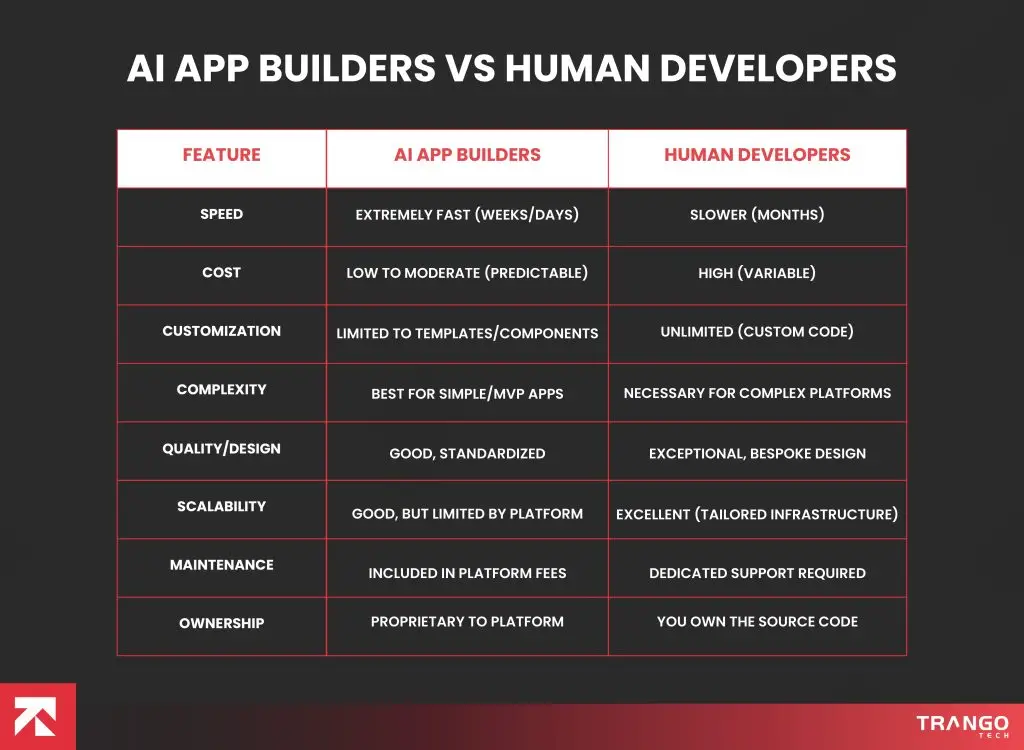
AI App Builders vs Human Developers (Quick Comparison)
Businesses are flocking to AI app builders to cut development time and costs. Everyone is talking about AI app builders versus human developers right now, mostly because these new platforms promise to build apps much faster and cheaper.
However, before making use of such tools, one must consider whether AI can deliver robust, enterprise-grade solutions or if it is limited to simpler applications.
Based on my personal usage, I have always felt something was missing when it comes to using AI for app development. Whether it’s design, development, or deployment, I feel there is always room for improvement. AI doesn’t think the way a person does, and it often skips the small things that make an application feel truly complete and robust.
Of course, speed is a massive advantage with AI. But, sacrificing long-term stability and code quality? If this is a live app and not a prototype, rushing is just creating a nightmare of technical debt.
For Simple Apps (Yes): If you are building a standard marketplace, simple SaaS, or MVP, AI builders can replace agencies.
For High-End Software (No): For apps requiring complex algorithms, high security, unique user experiences, or custom integrations, human developers are essential.
Honestly, the future is looking entirely hybrid. Agencies aren’t just using AI to speed things up, which tells me it’s going to be a ‘human-in-the-loop’ approach that dominates, not a total AI takeover.
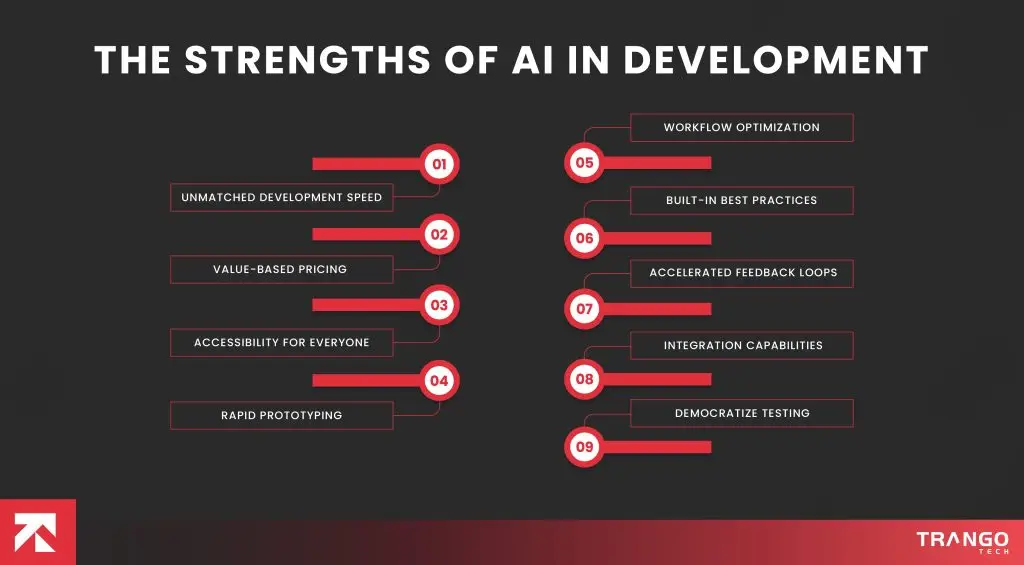
The Strengths of AI in Development
AI app builders have redefined the way applications are created. It primarily has been very useful for those who prefer speed, efficiency, and experimentation. As a matter of fact, traditional development cycles are no longer feasible. Most individuals and app development companies strongly ensure the use of AI to accelerate production.
What makes AI more interesting is the zero chance of error and better accessibility. Such strengths only pay off when applied in the right context. Simply put, AI ace development is particularly for MVPs, prototypes, and moderate applications. Below are a few more areas where AI provides a greater advantage:
1. Unmatched Development Speed
Speed is so far the most defining advantage of AI in app development. Projects that once took weeks to code are now just a matter of prompts. We believe AI can code 10X faster than human developers.
More interesting, it can generate entire structures, design layouts, and workflows almost instantly. You will rapidly deploy ideas to test innovations and seek real users’ feedback.
2. Value-Based Pricing
AI app builders significantly reduce development costs by about 1/4. You don’t need to hire a massive team to get the job done. Just acquire a platform with a monthly or fixed-price subscription to make your budgeting far more predictable. As a result, it removes financial uncertainty that arises when we hire developers or agencies.
3. Accessibility for Everyone
Besides developers, designers, and project managers, AI is accessible to less tech-savvy individuals, too. If you are an entrepreneur, marketer, or business owner, building an app is now as easy as pie.
You ought to have a firm grasp of language, prompt and detailed, to make the most of it. This democratization of technology empowers more and more people.
4. Rapid Prototyping
Businesses using an AI app builder test an idea more effectively and invest in a lucrative product. As a matter of fact, around 29% of IT projects are missed deals, which further grows the importance of AI.
This reduces risk and enables faster iteration, which you would definitely love to do. Consider it as a kind of quick first draft to decide whether to go or not.
5. Workflow Optimization
AI is an ace at handling repetitive and protracted tasks. Writing boilerplate code, debugging basic errors, and running automated tests, to name a few.
As a result, developers enjoy swift development and save a lot of time. Time is money; they will utilize that to dive into the more strategic and creative aspects of the project.
6. Built-In Best Practices
Unlike conventional development, you don’t have to do everything right from scratch. With standardized structures for code, UI components, and workflows, it becomes easier to maintain consistency with AI app builders.
Let’s assume that if you are a business without technical oversight, this built-in guidance will help you achieve stable, reliable outcomes.
7. Accelerated Feedback Loops
No matter what stage your project is at, app changes can be required at any moment. With AI-driven platforms, you can effortlessly add, modify, or remove features swiftly.
There is little need to write large portions of code. Those who respond to early user feedback will remain very relevant and ambitious.
8. Integration Capabilities
Your app will require built-in integrations for services, such as payment gateways, CRMs, or analytics.
With AI app builders, you eliminate the need for complex custom integrations. Businesses without any extra efforts will merge their apps with existing systems. Just click and enjoy existing tools.
9. Democratize Testing
Perhaps the most overlooked strength of AI is its ability to encourage experimentation. Due to being fast and affordable, businesses can easily test ideas without significant risk.
It fosters innovation and opens a window to opportunities previously overlooked. In contrast, if you do all this, it can feel like a lot might cost a fortune.
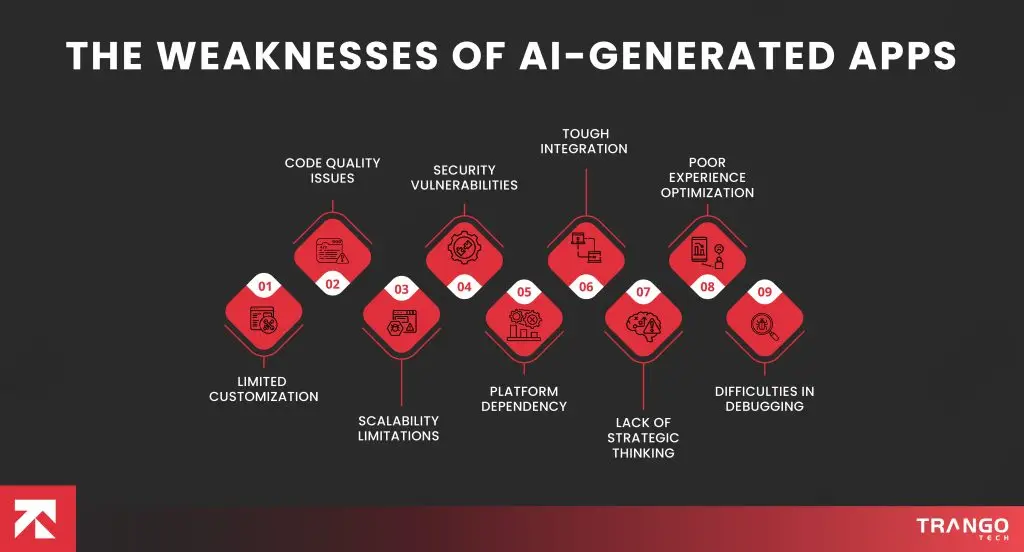
The Weaknesses of AI-Generated Apps
Speed and convenience with AI app builders come with trade-offs that are not immediately visible. At first glance, these platforms seem like a complete solution, especially for businesses eager to launch quickly.
However, once you move beyond basic functionality and start thinking about scalability, performance, and long-term growth, the cracks begin to show.
To be real, AI-generated applications are currently in early stages. They are excellent for prototyping and simple use cases, but when applied to complex, real-world business environments, their limitations become more apparent.
Here is why AI stands weak when it comes to complex projects:
Limited Customization
The use of pre-existing templates and modular units is one of the most evident negative aspects of AI app builders. Although this method makes the development process easier, it greatly limits flexibility.
To compete in the marketplace, businesses may require special workflows, special features, or special user experiences.
Artificial intelligence is not able to provide such a high degree of personalization, and this leads to apps that are generic and undifferentiated.
Code Quality Issues
AI is able to produce code more rapidly; however, this does not necessarily equate with quality. The generated code is usually working, but not well organized, optimized, or readable.
This can be a big problem when developers are later required to scale or make changes to the application.
Improperly written code creates technical debt, complicating future modifications and increasing their time and cost.
Scalability Limitations
Artificially intelligent applications can be effective at the beginning or with a limited number of users.
These applications, however, rarely scale effectively as systems become more complex and more traffic is added.
AI tools are not usually designed to consider long-term growth, which may lead to bottlenecks in performance and failure of the system under pressure.
Security Vulnerabilities
Security is a very important part of any application (particularly one that involves sensitive user information). Advanced security practices or new threats might not be considered by the AI app builders to the full extent.
They also tend to be shallow in detecting and addressing vulnerabilities, which may subject businesses to data breaches, compliance problems, and reputational losses.
Platform Dependency
Numerous AI application developers run on proprietary systems, which implies that the code and infrastructure are tightly managed by the host. This restricts your ownership and flexibility.
Should you choose to change platforms or scale not supported in the tool, you may find it challenging and expensive to migrate your application. This addiction poses a long-term threat to expanding companies.
Tough Integration
Contemporary apps tend to be dependent on several third-party services, APIs, and enterprise systems.
Complex integrations may be a challenge that AI builders face, particularly when the connections are customized.
This constraint can cause companies to not be able to utilize their current tech stack to the fullest or to extend the functionality of the app.
Lack of Strategic Thinking
Artificial intelligence does not work on the basis of knowledge but rather patterns and information.
They are not able to read business objectives, user intent, or market dynamics in a similar manner as a human developer does.
This translates into applications that can be functional, yet not strategic to the business goals, which ultimately impact the user engagement and growth.
Poor Experience Optimization
Although AI may be able to compile interfaces, it usually lacks the nuances that make a user experience so special.
Human intuition and creativity are needed in navigation flow, micro-interactions, accessibility, and emotional design.
AI-created apps might appear to be okay on the face of it, but they do not usually provide a smooth and engaging experience.
Difficulties in debugging
In cases of problems in AI-generated applications, debugging may be a complicated task.
The unstructured code and documentation complicate problem identification and resolution by the developers.
It is even more difficult to maintain over time, when additional features are introduced, or systems develop.
However, any honest Builder.ai review will tell you that while the Lego-block approach works for standard e-commerce or simple service apps, it begins to fray when you step into the territory of unique, innovative features.
Where Human App Developers Outshine AI Tools
Though AI app builders to some extent are quite impressive in terms of speed and automation. However, they still operate within predefined logic, templates, and pattern-based decision-making.
At the same time, human developers, on the other hand, bring real-world thinking, experience, and adaptability to development.
Apps built by real human developers are found to be more aligned with your business goals, user expectations, and visions. Below are several key strengths that make them irreplaceable:
Comprehensive Business Knowledge
Human developers do not simply create what is requested, but they know the reasons why this is necessary. They spend time studying the business models, target audiences, revenue targets, and workflows before they write even a single line of code.
This enables them to correlate the product to actual business results as compared to technical outputs. AI tools, on the contrary, frequently lack this strategic interpretation layer.
True Problem-Solving Ability
The development of software is not often a simple task. Bugs, unforeseen user action, system crashes, and integration issues occur daily.
Human developers are best suited to such circumstances since they are able to think critically, debug creatively, and uncover solutions that are not defined.
AI tools tend to be based on established patterns, restricting them to unique or complex problems.
Advanced Customization
Complete freedom in customization is one of the largest benefits of human developers. They are not limited by drag-and-drop elements and ready-made modules.
Rather, they are able to create complete custom architectures, distinct capabilities, and specialized workflows that fit precise business needs. This degree of flexibility is necessary with competitive and high-growth applications.
Scalable Architecture Design
Systems are developed by human developers keeping in mind the future growth. They take into account database optimization, server load, caching strategies, and microservices architecture as necessary.
This will make sure that the application runs smoothly even as the number of users grows. This type of architectural planning is not always present in AI-generated applications, which are quick to develop.
Strong Security Management
One of the most important features of modern applications is security. Human developers can comprehend encryption rules, authentication procedures, data protection regulations, and vulnerability prevention methods.
They are proactive in developing mechanisms to reduce threats such as data breaches and intrusions. AI tools can produce working code, although they can often fail to cover security edge cases.
Better Performance Optimization
Performance is not only the performance of making an app work, but of making it fast, efficient, and responsive to load.
The human developers are able to optimize the backend queries, lower the API latency, enhance the rendering speed, and optimize the use of resources.
These optimizations involve intricate technical understanding that cannot be automatically applied by AI applications.
Seamless Third-Party Integrations
The use of modern applications is highly dependent on integrations like payment gateway, CRM, analytics, cloud, and APIs.
Human developers are able to manage complex integrations, address compatibility problems, and adapt workflows across two or more systems.
AI platforms frequently only have a few or standardized integrations, which may limit business functionality.
Strategic Product Thinking
Human developers do not just think code; they think user experience, interaction, product psychology.
They work with designers and stakeholders to design interfaces that are easy to use and enhance retention and satisfaction.
This type of thinking is strategic in that it makes the product not only viable but also competitive in the market.
Evolutionary Upgrades
An effective application will never be a completed one. It must be constantly updated, fixed, improved, and enhanced with new features.
Human developers provide continuous maintenance with a long-term vision for the product.
They upgrade the system as per the user feedback and market dynamics, which AI tools are not designed to effectively handle.
Limitations of Human App Developers You Should Know
Experienced developers are crucial for software, but their capacity for handling extreme complexity is finite.
You can’t expect perfect results by just hiring experienced developers or agencies automatically. This is primarily because software development is a complex, human-driven process. Time, cost, communication, and technical variability directly influence it.
When you know the potential challenges, it becomes easier to plan, set realistic expectations, and collaborate. Here are limitations you should consider when working with human app developers:
High Development Costs
You get what you pay for. Experience in hiring may require a lot of financial support to hire seasoned developers, particularly to develop custom or enterprise-level applications.
This comprises salaries, agency fees, infrastructure expenses, and maintenance costs.
These expenses can act as an entry barrier in app development for startups and small companies within just a few days, requiring them to delay development or seek other solutions, such as AI app builders or no-code platforms.
Longer Development Timelines
Human development is time-consuming, as opposed to AI tools that can create prototypes within a short time.
Starting with the planning and design, then proceeding to the coding, testing, and deployment, all these stages must be executed with care. An app may need several months or even more to be finished, depending on its complexity.
Although this guarantees higher quality and stability, it may be a setback to those businesses that want to penetrate fast and have a presence in highly competitive markets.
Variability in Skill and Experience
Not all developers are equally skilled. There are those who can perform well in frontend development and have no knowledge of the backend, or those who are not conversant with modern frameworks and best practices.
This inconsistency may be reflected in the quality of the final product. Companies usually have to take more time to screen candidates, review their portfolios, and hold technical interviews to make sure they recruit the appropriate talent.
Communication Gaps
The development of software is very collaborative, and without the right AI project management tools in place, a lack of communication may result in miscommunication, delays, and rework.
This aspect is even more evident in the remote or outsourced teams, whereby time zones, language differences, and vague requirements can be a source of tension.
Even minor misunderstandings of project requirements may lead to the development of features in the wrong way or their irrelevance to business objectives.
Dependency on Human Availability
There are boundaries to human developers with regard to working hours, productivity, and availability.
In contrast to automated systems, which are active 24 hours a day, developers need to rest, take breaks, and have schedules.
When the critical members of the team are not available because of leave, project, or workload reasons, then it may slow down the pace and can also impact delivery schedules. This addiction may occasionally interfere with the continuity of development.
Risk of Technical Debt
When developers are under pressure to deliver quickly or work within tight budgets, they may take shortcuts in coding practices.
While this helps meet deadlines, it can lead to technical debt, poorly optimized or messy code that becomes difficult and expensive to maintain later.
Over time, this can slow down updates, introduce bugs, and increase long-term maintenance costs.
Difficulty in Scaling Teams Quickly
Under the pressure of having to produce fast or working with restricted budgets, developers can make shortcuts in their coding practices.
Although this assists in deadlines, it may cause technical debt, poor optimization, or sloppy code, which is hard and costly to clean up in the future.
This may, over time, slow down updates, add bugs, and add long-term maintenance expenses.
Inconsistent Delivery Quality
Even seasoned developers can provide different quality levels based on the complexity of the task, time constraints, or workload.
There are those projects that can be given extra attention and others that may not be given the same attention.
Such inconsistency may impact the user experience, performance, and the reliability of the application in the long run.
Vendor Dependency
After creating an application, it needs to be constantly updated, fixed with bugs, and improved with new features.
Companies are usually addicted to the initial creators or agency to maintain it. When the team is unavailable or evolves with time, it may result in difficulties accessing existing codebases.
This addiction may reduce the rate of improvement in the future and add to the long-term expenses.
Bonus Read: Check our end-to-end guide on AI App development cost to know before starting the next project.
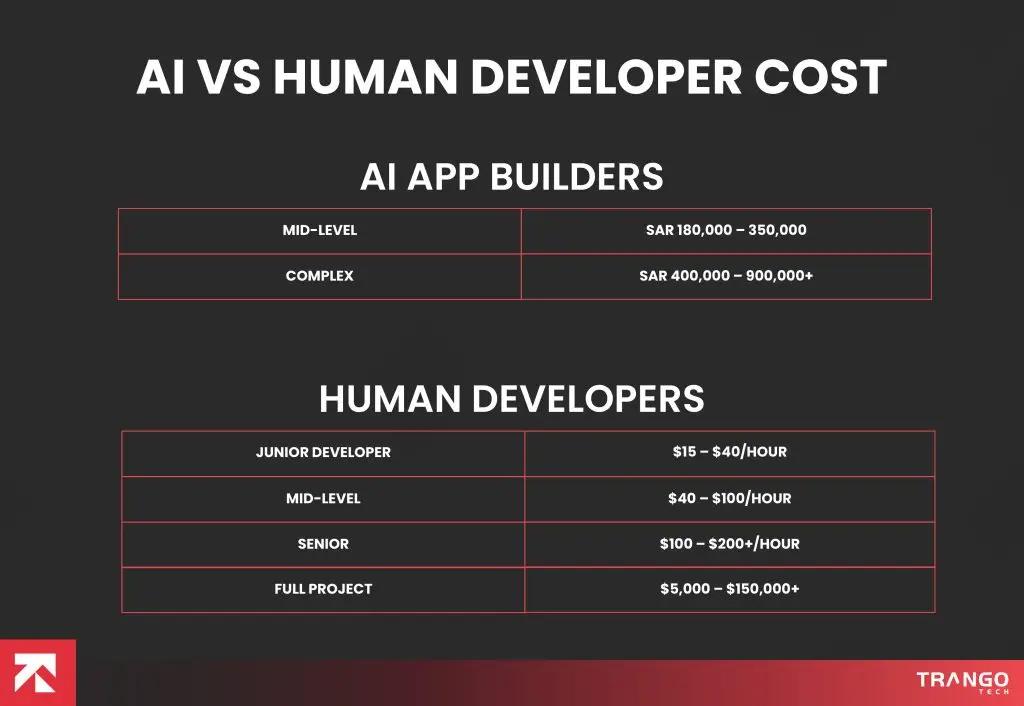
AI vs Human Developer Cost Comparison
Hope you are now very clear about choosing between AI app builders vs human developers. The next and final comparison is about how the cost assorted to development of both varies.
AI promises you speed, affordability, and automation. On the other hand, human developers bring creativity, problem-solving ability, and deep technical expertise. Both are good in their own ways.
We recommend that you don’t understand the cost in terms of money alone. Check for time, scalability, maintenance, and risk. Based on our experience, here is how much you should expect for AI-based development and human developers:
Category
AI Development Cost
Human Developer Cost
Pricing Model
Subscription-based (monthly/yearly)
Hourly rates, project-based pricing, or salaries
Entry Cost
Some tools are free or low-cost
No free option—paid expertise required from the start
Setup Requirement
Minimal setup, ready-to-use platforms
Requires hiring, onboarding, and project planning
Team Requirement
No need for large teams
Often requires developers, designers, testers, etc.
High-quality, scalable, and custom-built solutions
Limitation
Limited customization and scalability
Higher upfront investment
AI tools are incredible for slashing upfront development costs and getting prototypes built in no time with very little cash. However, hiring human developers is still worth the higher price tag when you need custom architecture, long-term scalability, and reliability that AI just can’t quite manage on its own.
End Note
AI app builders have undeniably changed the way we approach app development. However, you can’t completely rely on it. Design, development, and deployment through AI still require refinements.
AI App Builders are good to go when:
You are building an MVP
You need a quick prototype
The budget is extremely limited
Project is simple (landing pages, basic apps, internal tools)
Human developers are the better choice when:
You are building a scalable product
Your app needs complex features
Security and performance matter
You plan long-term business growth
You need full customization
Remember that certain issues like restricted customization, platform dependency, security gaps,
and technical debt are serious challenges to consider. If you are stuck in such a situation, skilled developers with the right hands-on experience and AI expertise can help you.
This is exactly what we have been doing at Trango Tech for the past 20+ years. See our portfolio of human-built custom applications. Our second first understands business logic, user behavior, and technical architecture in a way that AI will take years to beat.
Answering Common Questions
1. Can AI app builders completely replace human developers?
Not really, AI is here to enhance capabilities and help them be more productive. As of now, AI app builders will take years to replace human tone developers. They need to evolve in many ways. But if you are working on basic applications and MVPs just to test your ideas, definitely give tools like Builder AI a try.
2. What are so far the biggest advantages of AI app builders?
Speed, affordability, and ease of use are what make AI app developers an incredible choice. You can build and launch your mobile application in a very short time with no coding skills required.
3. Do AI-generated apps have any limitations?
AI-generated apps are quite difficult to customize, scale, and ensure long-term reliability. This is because it is built on templates and predefined structures. There is hardly any chance of any creativity and uniqueness. Besides that, it may introduce technical debt that later adds up a lot in your expenses.
4. How are no-code tools and custom development different?
No-code tools rely on pre-built components and templates, which makes development fast but limited. Custom development is built from scratch. It allows full control over features, design, performance, and scalability.
5. Are human developers still better?
AI, unless it has problem-solving skills, creativity, and strategic thinking, will never be able to replace real humans. Human developers know who is who and what is what for business requirements, and end up with truly impactful systems.
6. What types of apps are best built with AI tools?
If you are starting small for MVPs, basic e-commerce apps, internal tools, landing page apps, or small SaaS products, AI will do it better than that, too, at very cheap rates. This is primarily because such projects do not require heavy customization or advanced backend systems; hiring real developers can cost you a fortune.
7. What types of apps do human developers do better?
For applications that belong to industries like fintech, healthcare, and enterprise, you can’t rely on AI. There will be circumstances where you have to consult with real developers for a solution. This is because projects from such industries seek better performance, scalability, and precision.
8. Is it better to hire an agency or use an AI app builder?
AI builders win on speed, allowing you to validate a concept in days. However, agencies win on strategy. If your goal is a robust, market-ready product rather than just a quick demo, the expertise of a development team is irreplaceable.
Daniyal is a passionate content writer & editor with 3+ years of experience crafting SEO-friendly blogs, web copies, and marketing content for an mobile app development company. He loves turning ideas into words that connect, engage, and deliver value. Currently working as a Senior Content Writer at Trango Tech, Daniyal holds a bachelor's degree in English Language and Literature.