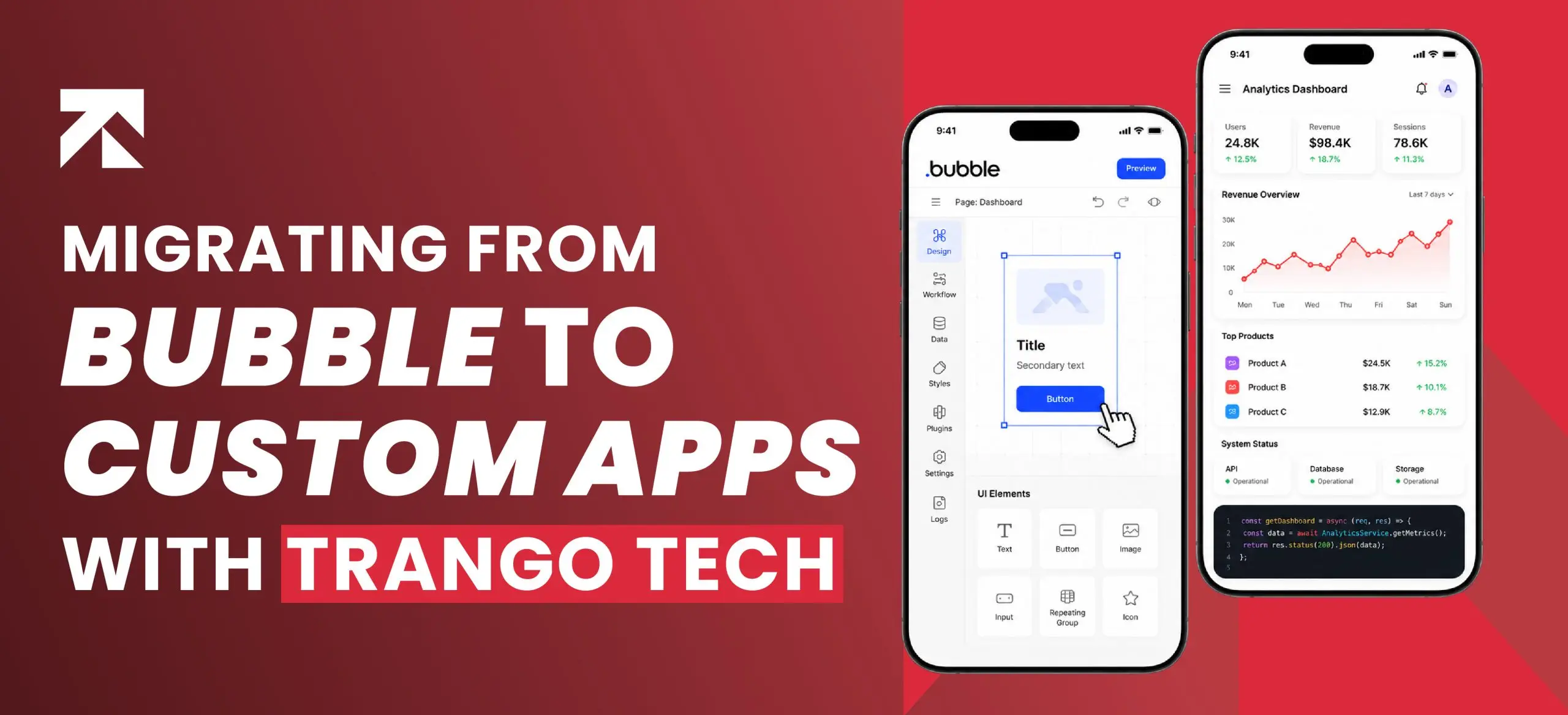
Many app builders begin to develop their apps with no-code tools like Bubble. This is an excellent tool to start with, as it allows you to launch a minimum viable product (MVP) quickly and affordably.
You have an idea, start implementing it on Bubble, and soon your app is ready to launch.
But as soon as your app starts to grow, you start noticing the friction. Your app slows down, you cannot include that one exclusive feature your users are demanding, and scalability becomes a major hassle.
These limitations highlight the need for a new approach. So, what is the solution?
It is simple and clear to migrate from Bubble to a custom app. This guide will walk you through the complete journey of Bubble to custom app migration. At Trango Tech, we help businesses make this shift smoothly.
Table Of Contents
What Does Migrating from Bubble to Custom App Mean?
Migrating from Bubble to a custom app means moving your app’s data, functionality, and user interface from the no-code platform Bubble to traditional custom app development.
It usually means developers rewrite all of the original app’s code using programming languages such as JavaScript or Python and frameworks like React or Vue.
This migration helps you overcome Bubble’s limitations and gives you full control over your app’s backend and frontend.
● Code Rewrite
To move from Bubble to full-stack development, you need to rebuild your app’s logic and UI using code because Bubble’s workflow cannot be transferred directly.
● Data Import & Export
You have to export your Bubble database and import it into your new backend database for smooth transitioning.
● Custom Backend Setup
You need to create and host your own backend development solutions and APIs, unlike Bubble’s pre-built backend.
● Frontend Redevelopment
You need to rebuild your app’s user interface (UI), which is what users interact with, using frameworks such as React, Flutter, or Vue. Frameworks are tools that help developers create applications efficiently.
Understanding these elements will make it easier for you to migrate from Bubble to a custom app.
Why Migrate from Bubble to a Custom App?
The decision to migrate from Bubble to a custom app is crucial, driven by Bubble’s limitations and scalability issues.
While Bubble is a great choice for building MVPs and simple apps, its limitations become a hurdle for your app’s growth.
Migrating from Bubble to a custom app overcomes these limitations and delivers a highly functional and scalable application.
● Performance Improvements
Custom app development provides optimized code and infrastructure. It offers apps with faster load times and enhanced user experience.
● Greater Customization
You can integrate any feature or design without any limitations.
● Scalability
Custom apps never fail as your business grows. They can handle more users and data by efficiently scaling backend services and the database.
● Cost Control
Hosting your own custom app is collectively lower than Bubble’s subscription plans.
The Limitations of Bubble
➔ Performance Obstruction
As your app’s user base grows, you notice it becomes slow. The page loads slowly, and you receive multiple inefficient database queries.
It happens because your app runs on a shared database (a system where multiple users’ apps store their data together) that isn’t designed for your use.
➔ Scalability Issues
Bubble scalability issues are a major roadblock, forcing users to migrate from Bubble to a custom app.
A sudden increase in app traffic can overburden the system, slowing it down. Because bubble’s architecture has limits on how many operations it can tackle, this can create hurdles for your growth.
➔ Vendor Lock-in & Lack of Control
Your app is totally dependent on the bubble, including its updates, price changes, and feature roadmap.
You’re not the owner of the main code and don’t have deep control over the hosting environment.
➔ Customization Constraints
Customization becomes nearly impossible, and you’ll find it difficult to integrate the API and the unique UI/UX elements.
➔ Long-term Cost Efficiency
As the usage and complexity of your app increase, you must subscribe to the bubble’s upper-tier subscription.
Over time, these recurring costs exceed the cost of a custom app you fully own.
➔ SEO and Technical SEO Control
You have less control over site architecture, URL structures, and server-side rendering, which can limit the effectiveness of advanced technical SEO strategies.
Plan to Migrate from Bubble to Custom Apps
A migration’s success is determined more by strategic planning (90%), with execution accounting for the final 10%.
Never rush this stage, as it may lead to increased costs and missed deadlines. Make sure to create a detailed plan.
1. A Comprehensive App Audits and Requirements
First, understand what you have and what you want to include:
Look closely at your bubble’s app and document everything, including its features, admin panel, workflow, and third-party plugins.
Make a list of must-have features and nice-to-have features. It helps you prioritize the features needed for the initial build.
Specify what your app will need in 2 years. Clarify your app’s goals for performance, security, and new integrations.
2. Secure Your Digital Assets
Your data is your most valuable asset. Handle it carefully to keep it secure.
Understand your data structure in Bubbles’ database. Export your data, typically via CSV files or an API.
Raw data is imperfect. Standardize formats, remove duplicates, and structure it to fit into your new database schema.
Data security is essential; implement secure methods for transferring and handling data.
3. Selecting the Right Tech Stack
Choosing the right tool is essential for building fast and scalable APIs.
For the backend, use Node.js or Python to build scalable, high-performance APIs.
To create an engaging interface, use technologies like React or Vue.
PostgreSQL is a type of relational database that organizes data into tables. MongoDB is a database used when flexibility in data structure is needed, allowing the storage of varied types of information.
4. Develop your Custom Code Plan and Architecture
Create a detailed project outline that includes timelines, milestones, and the budget.
We create the system’s design and an efficient and scalable plan for your new database.
We create a clear API strategy that clarifies how your frontend and backend communicate and how you’ll integrate with other services.
Process to Move from Bubble to Custom Apps: Step-by-Step Guide
This is a step-by-step guide to help you move from Bubble to custom apps. Follow this systematic plan to execute the strategy accurately.
1. Database Design and Migration Execution
Build the new Database: We create a new, optimized database schema (a blueprint for how data is organized) during the planning stage.
Import & validate the Data: The data is securely imported from your Bubble app. We run validation scripts to validate the accuracy of every piece of information.
Migrate File & Media Assets: media files, including images, and other media, are transferred from bubble to your new cloud storage system, such as Amazon S3.
Backend Development: The backend is the engine of your application. It includes the following aspects:
2. API Development
We develop a set of strong and secure APIs that handle all the functionalities, starting from user login to processing payments.
Business Logic Implementation: The fundamental rules and workflows are translated from Bubble’s logic into clean, efficient code.
Authentication & Authorization: We implement a secure system for user management and access control so that users can only see and do what they are allowed to.
Frontend Development: This is very important, as this is what your users see and perceive.
3. UI/UX Redesign And Recreation
We design an interactive, engaging user interface based on your design. We convert a visual concept into a high-performing, functional user experience.
Connecting to Backend APIs: The front end is efficiently integrated with the backend, guaranteeing accurate data flow, and the app starts to feel responsive and fast.
Cross-Browser and Device Compatibility: Your app is tested thoroughly to make sure it works perfectly across all major browsers and devices.
Third-party Integration and Custom Features: We connect your app with the outside world and create what was impossible with Bubble.
4. Reconnect Services
We integrate essential services into your app, like payment gateways (PayPal, Stripe), Analytics tools (Google Analytics), and email services (SendGrid).
Develop Custom Integrations: We create custom connections to any niche and proprietary APIs your business depends on.
Rigorous Testing and Quality Assurance: Before launching your app, we make sure that everything is perfect.
Comprehensive Testing: We perform thorough testing, including unit, integration, performance, and security testing, to detect and fix any bugs or errors.
User Acceptance Testing: We ask you and your team to test the app to confirm if it meets all your requirements.
5. Deployment and Launch Strategy
We offer a smooth and efficient launch.
Cloud infrastructure setup: We create a secure hosting environment on platforms like AWS or Google Cloud.
Go-Live Plan: We implement a carefully planned migration from Bubble to custom apps.
Common Challenges in Bubble Migration and Trango Tech Solutions:
Custom app development after Bubble comes with several challenges. But Trango Tech’s professionalism and expertise allow us to overcome these challenges easily.
1. Rebuilding Complex Workflows
Bubble’s database can be complex and needs to be shifted carefully into the backend code.
2. Data Consistency Issues
Managing the export and import of data is quite challenging, as it can lead to data loss or disruption.
3. UI Replication Difficulties
Copying the same drag-and-drop for the bubble can be time-consuming and may require redesign.
4. Integration Rewrites
APIs and third-party integrations in Bubble have to be reconnected and tested in the new stack.
We have proven expertise in migrating from Bubble to custom app development, making these challenges manageable.
Partner With Trango Tech for Migrating from Bubble to Custom Apps
We have exceptional expertise and hands-on experience in no-code-to-code migration and full-stack development.
We follow a rigorous five-step process: discovery, design, development, testing, and deployment.
We have a team of skilled and dedicated developers, designers, and project managers working on your project.
Conclusion
Migrating from Bubble to a custom app is an investment that offers greater scalability, control, and customization. It gives you complete freedom, and you’re no longer restricted to the platform’s limitations.
With a complete understanding of the migration process, choosing the right tech stack, and knowing the common challenges that may come your way, you can successfully migrate from Bubble to custom apps.
How long does it take to migrate from Bubble to custom apps?
The timeline varies greatly depending on the app’s complexity, but a typical Bubble-to-custom migration may take 3 to 6 months.
What are the main cost factors involved in the bubble-to-custom app migration?
The fundamental costs are driven by the number of features, the complexity of the business logic, the volume of data to be migrated, and the UI/UX design.
Will my data be secure during the no-code-to-code migration?
Yes, Definitely! We follow strict security procedures, such as encrypted data transfer and secure handling. We ensure your data remains secure and protected throughout the process.
What happens to my bubble app once the custom app is launched?
We recommend keeping your app live in read-only mode for a short period as a backup. Once the new custom app is secure and reliable and all data has been verified, you can deactivate the Bubble app.
Is it possible to keep using Bubble after migration?
Yes, you can maintain the Bubble app separately; after migration, your app runs independently of Bubble. The migrated app will not depend on Bubble’s platform.
Qurat-ul-ain is a skilled content writer and proofreader with 4 years of experience creating compelling content across SaaS, mobile app company, and tech industries. She excels at defining brand voices and managing the full content lifecycle, from planning to execution. Currently working as a Senior Content Writer, she holds an MBA degree in Marketing.