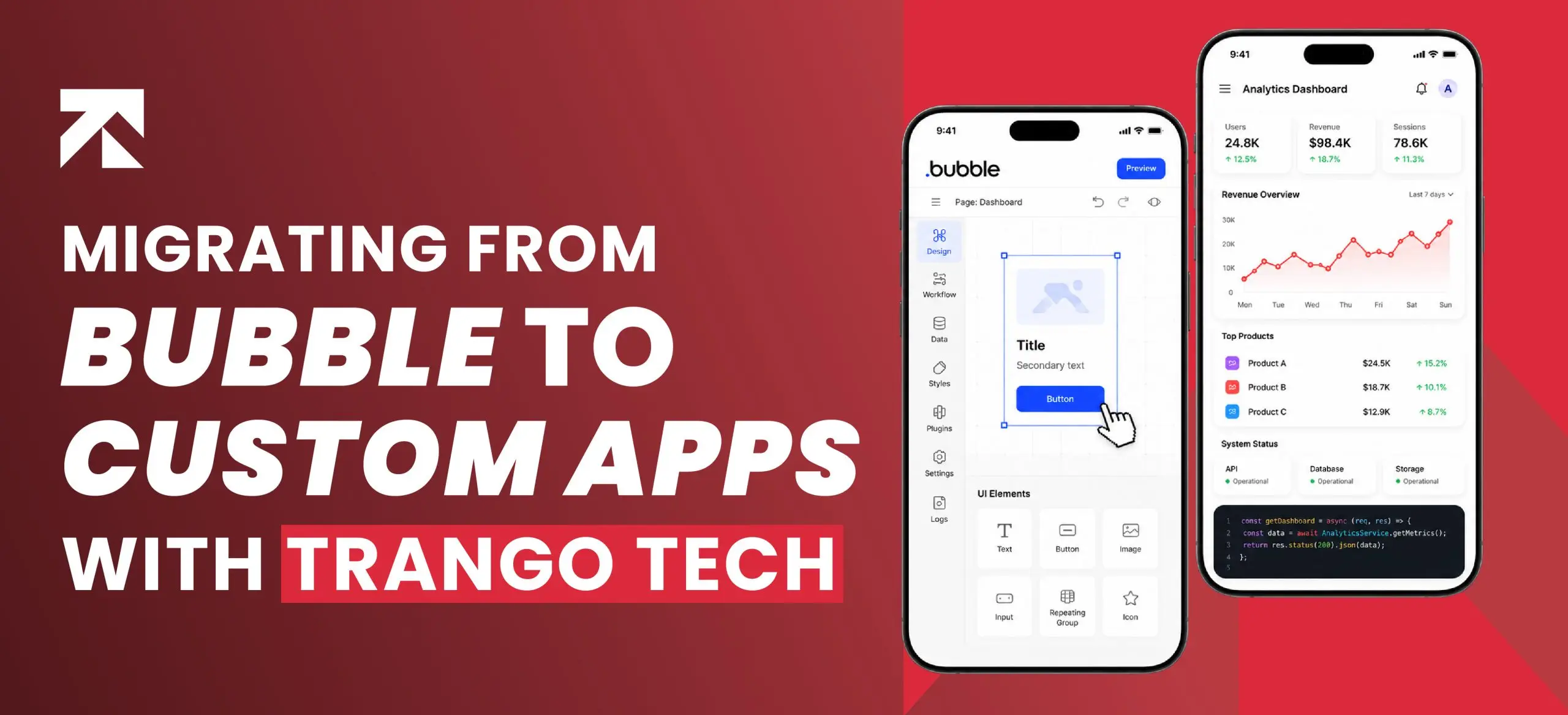
Startups and non-technical founders building apps on Bubble often encounter obstacles that prompt a switch from Bubble to custom app development.
If you find yourself explaining backend logic to investors or your development team struggles to update core workflows, it may be time to consider switching.
Furthermore, Bubble also offers limited functionality for personalized solutions, even adding new features for weeks due to plugin constraints.
These are the times when relying on a no-code platform like Bubble pulls you away from your business goals.
This is why moving from Bubble to custom app development holds significance for startups and businesses.
In this guide, you’ll get a greater understanding of why startups make the switch to custom apps.
Table Of Contents
Key takeaways from this Guide:
What is Bubble?
Reasons why startups are switching from Bubble to Custom Apps
Signs you need to switch from Bubble to Custom apps
Step-Wise Plan to Switch From Bubble to Custom Apps
How Trango Tech Helps Businesses to Create Custom Apps
What is Bubble?
Launched in 2012, Bubble is a powerful, no-code platform for building web and mobile apps without writing code. Building in a bubble means you’re creating a full-stack application through a visual interface.
It enables non-technical founders and businesses to create everything from MVPs to full-fledged SAAS solutions, using a drag-and-drop tool.
Why Startups Switch From Bubble to Custom Apps?
For startups or small businesses, Bubble is an easy, quick option, but as you scale, some Bubble limitations for startups may become a hurdle to your growth.
Most of the time, bubble scalability issues trigger startups to switch from Bubble to custom apps, but there are some other limitations as well. Let’s look at how these limitations affect your business.
1. Performance Declines
● Apps Slowdown due to Heavy traffic:
Bubble runs on shared servers, so when traffic on your app increases to 20,000+ users, it starts slowing down.
Not just traffic, but also the app’s complexities affect speed. For example, when you integrate live chat or real-time dashboards, performance declines: page load times slow down, and actions take longer to complete, disrupting the user experience and causing users to leave the app.
● Limited Data Processing:
If you want to develop something crucial like an analytics dashboard, Bubble becomes outdated because its database handles only 100 rows per second, which is not enough.
Whereas a custom solution, such as PostgreSQL, handles 10,000 rows/second, which is 100 times faster
Reach out to us for your custom mobile app development service. We have expert iOS app developers, while also offering professional and reliable Android app development services.
2. You Can’t Export Your Code
● You’re Caged in the Bubble Ecosystem:
Your app is your property, and you deserve access to its code, but the most irritating part of Bubble is that it blocks you from downloading it. If you plan to switch platforms later, you must rebuild everything from scratch.
● Rebuilding is Expensive:
At some point in your journey, you may decide to move your bubble app to a custom tech stack, but what if switching eats up a big slice of your savings?
Yes, that’s true: moving your bubble app to a custom tech stack may cost $10,000 to $50,000, depending on complexity. That’s a big figure when you’ve already invested your time and money into the first version.
3. You’re Obliged to Follow Their Rules
Using Bubble means you’re bound to follow everything, including pricing, updates, and the plugin system.
If Bubble increases prices or changes key plugins, you must adapt to the changes.
Even small plugin changes can break integration, and you must hire a developer at $25-$100/hour to fix them.
4. Cost can Get Out of Control
● Pricing Plans Scale Fast:
Bubble prices can quickly get out of hand. You may start with a $29/month plan, but as you grow, prepare to pay $3,500+/month for the Enterprise version.
Hidden Costs Breakdown:
Plugin fees: $10- $100/months
Workload Overages: $29 / 200,000 units
The combined annual cost may exceed $42,000.
Many startups fall into this trap, thinking they’ll save money by launching on Bubble, only to later pay $30,000+ per year to keep the app running.
Signs You Need to Switch From Bubble to Custom Apps
To make things clear, here is a quick checklist you can analyze to switch from Bubble to Custom Apps.
1. Your App is Becoming Slower
A large number of users or a large amount of data can slow down your app. Founders report page loading times slowing to 2-3 seconds.
2. You’re Paying Devs to Patch Things
You must hire a developer to implement a custom API or advanced logic, which defeats the purpose of choosing no-code.
3. Features you want are Not Supported by Bubble
You may want to add advanced, real-time features that Bubble doesn’t offer, such as collaborative editing, custom animations, or native mobile apps.
If you are planning to switch from Bubble to custom apps, here is a detailed plan to guide the process.
Your Step-Wise Plan to Shift From Bubble to Custom Apps:
Here’s an 8-step plan you can implement to migrate from Bubble to a custom app. Follow these steps to handle the migration process effectively without any disruptions.
1. Assess Your Bubble App
Record key features, workflows, and integrations.
Identify performance bottlenecks and plugin limitations by analyzing logs and reviews.
Export your app’s data through Bubble’s APi.
2. Define Custom App Requirements And Tech Stack
First of all, define your goals for your business, such as 200,000 users, 50% faster loading time, and other factors.
Select an appropriate tech stack accordingly for frontend, backend, and database.
Next, plan your budget, timeline, and platform compatibility to meet your business needs.
3. Build Your Team
Now, build your team. Recruit experts across every domain, including frontend and backend developers and designers. Find experienced individuals through job platforms or hire a professional custom app development company like Trango Tech to handle all tasks independently.
4. Design for Scalability
Create an architecture with scalability in mind to support growth and adaptability. Use examples like AWS ECS for storage, SQS for task queues, and middleware to decouple Bubble’s components.
Make sure the design aligns with your app’s long-term requirements.
Apply performance optimization techniques.
5. Rebuild Core Features
Integrate essential features only and develop a minimum viable product (MVP) effectively.
Redesign UX/UI to maintain user familiarity, use Bubble as a reference.
Test all workflows, APIs, and integrations to ensure they meet performance expectations.
6. Test Thoroughly
Conduct thorough integration and load testing to guarantee functionality.
Compare your results with Bubble to understand improvements.
7. Roll Out Smoothly
Sync data between Bubble and the new app smoothly
Communicate clearly to minimize disruption and migrate users gradually.
Disassociate from Bubble via DNS redirection after achieving the desired custom app performance. During this migration phase, it is crucial to monitor your DNS traffic to ensure all user requests are correctly routed to the new servers without interruption.
8. Optimize And Refine With CI/CD
Improve development workflow with automated testing and deployment.
Monitor and improve the app continuously to guarantee success.
Speed Gets You Launched, Scalability Keeps You Running
Do not sacrifice your app’s scalability for speed. Choose a solution that delivers both at reasonable prices.
With quick validation and MVP development for startups, Bubble attracts them because non-technical founders can test their ideas early.
However, it has multiple limitations, such as a lack of customization and performance issues. In contrast, custom code helps you achieve strong, long-term scalability with complete security and integrations.
However, it needs significant time and investment, but it is worth investing in custom apps. With Trango tech, you can achieve both speed and scalability, creating a customizable platform that grows with your business.
How Trango Tech Helps Startups Build Custom Apps
Trango Tech can help you migrate from bubble to custom app development with no headache and chaos, just a highly functional and scalable solution.
We help you integrate AI features into your app, such as content generation, recommendations, and chat. With a full-fledged development team, QAs, DevOps, and project management, your app is in safe hands. We are well-versed in cross-platform app development, whether you need Flutter app development or React Native app development.
See our portfolio of custom-built apps.
Frequently Asked Questions
Q. Can I export a Bubble Database?
Yes, you can export the bubble database, but only via CSV files or API calls, which may not capture all the data exactly. Bubble allows you to export user data, transactions, and custom content. Whereas this export does not include workflow logic or app architecture.
Q. What are the disadvantages of using Bubble instead of a custom app?
Bubble offers faster app development, but it has several drawbacks, including:
Performance and scalability issues, which means the load time is slower.
It offers limited customizations and is unable to handle constraints and HIPAA-compliant apps without workarounds.
Subscription fees increase with usage
It has a steeper learning curve for non-visual tasks.Q. How to export data from Bubble?
Bubble allows you to export data in CSV format from the data tab with backups in tools like Excel. Data API also supports fetching for external systems, but it needs some technical setup.
But keep in mind that a data export is limited to content and workflows, or app logic can not be exported.
Q. Is Bubble low code or no code?
Bubble is primarily a no-code platform allowing non-technical people to create web apps using drag and drop tools and visual workflows without programming knowledge. It enables businesses to create apps quickly without code.
Q. Can I integrate Bubble with my existing business system?
Yes, Bubble.io supports integration with business systems through its plugin ecosystem and API connector, allowing connection with tools like CRMs, payment processors, or automation platforms.
Qurat-ul-ain is a skilled content writer and proofreader with 4 years of experience creating compelling content across SaaS, mobile app company, and tech industries. She excels at defining brand voices and managing the full content lifecycle, from planning to execution. Currently working as a Senior Content Writer, she holds an MBA degree in Marketing.