Detroit, known as “Motor City,” stands at the forefront of automotive transformation, where digitalization is reshaping the entire industry. It leads in automotive production, manufacturing 1.7 million vehicles annually.
Detroit builds the world’s greatest cars. Now it’s trying to build the software that runs them. Ford, GM, and Stellantis are going electric. They are adding screens, sensors, and internet connections to every vehicle they make.
And suddenly, they need apps and software tools they never needed before. That’s where opportunity knocks in, and that’s exactly why more automotive startups and businesses are investing in custom apps development in Detroit.
Automotive digitalization in Detroit is rapidly shifting the industry from hardware-centric manufacturing to software-driven services. Whether you’re managing fleet operations, dealer networks, supply chain data, or EV charging logistics, the right app can make all the difference.
Trango Tech builds those apps, and we understand the Detroit automotive market well enough to build them right.
Transform your automotive business with our digital solutions!
Table Of Contents
Digitalization in the Automotive Industry: What Does it Mean?
Digitalization in automotive means using digital tech at every process stage. This transformation relies on software, data analysis, and AI to improve vehicle design, manufacturing, and efficiency.
With this transformation, manufacturers can virtually test products and refine designs, thereby speeding up production cycles and reducing costs. Once designs are validated, many teams rely on precision CNC machining for tight-tolerance parts to produce functional prototypes and production-ready components that match digital specifications.
Digitalization also allows manufacturers to better understand growing consumer needs, enabling the development of more connected and autonomous vehicles that enhance user experiences.
How Does Digital Technology Affect the Shift in the Automobile Sector?
Digital technology has transformed the automobile industry in various ways. Here are a few of the major transformations occurring in this sector.
Development of Products:
Digitalization improves vehicle design and performance, eliminating the necessity for physical prototypes.
It also accelerates development, reduces costs, and fosters innovation across the entire process.
Autonomous System and Simulation:
Simulation technology is also necessary as it makes the development process much easier by allowing you to predict outcomes, test designs, and optimize the process.
Connected Vehicles:
A large number of people are turning to connected vehicles. According to the S&P Global Mobility Report, the global volume of connected vehicles will reach 76 million annually by 2030. By 2050, fully electric, self-driving vehicles will be common.
Smart Manufacturing:
Integrating AI, IoT, and robotics into vehicle manufacturing enhances vehicle performance and production quality.
Real-time data and predictive maintenance help manufacturers monitor processes and prevent interruptions.
Efficiency in Supply Chain Management:
Digital solutions fill communication gaps among producers, intermediaries, and customers while also improving stock control, client supply, and overall supply chain quality.
Digitalization in Detroit’s automotive industry drives software development efforts in several specific areas:
Connected Vehicle System: App development for the vehicle telematics, battery management system, and real-time data processing for connected cars.
Mobility Innovation Hub: A combination of advanced aerial testing (drones) with EV and autonomous technology integration.
Smart Manufacturing: Using IoT and sensor analytics in factories, with investment in production automation.
AI-First Development Models:
By 2026, AI will be essential for enterprise solutions. AI-Enabled Supply: AI integration is moving into the supply chain management, logistics, and predictive analytics to improve visibility and demand planning.
Organizations are investing in integrating LLMs into workflows to create custom enterprise AI agents.
Digital Transformation & Legacy Modernization:
Local enterprises are replacing legacy systems and implementing cloud-native architectures.
Workflow Automation:
Companies want to automate workflows to connect factory operations to cloud ERP systems for faster release cycles.
Cross-platform Apps:
Demand for frameworks like React Native and Flutter is rising to unify user experience and lower costs.
Strong Cybersecrity & Clients:
As application numbers grow, security considerations become increasingly critical for protecting sensitive data.
Zero-Trust Security:
Security needs attention, so there is a need for data-driven tools that require secure, encrypted storage and strict compliance for apps that interact with complex, high-frequency data.
HIPAA/Data Compliance:
There’s a need for deep security audits and specialized expertise, especially for healthcare and fintech apps.
Talent Ecosystem and Infrastructure Support:
Detroit supports a sustainable tech ecosystem through partnerships, incubators, and collaboration.
A specialized local talent pool is driving Detroit companies to hire local Android and iOS developers.
Growing Startup Scene and regional Investment:
Detroit is a fast-growing startup hub, recognized as a top emerging AI center, with an increasing number of fintech and marketplace startups.
Over five years, $4.4B was invested domestically and $4.6B internationally in Detroit custom app development for industry and logistics.
Key Components of Digitalization in the Automotive Industry:
The main components of digitalization in the automotive industry include:
IoT Integration:
Providing internet connectivity in vehicles enables data exchange and remote monitoring.
AI and Machine Learning:
The integration of AI and ML enables better decision-making and improves both driving safety and manufacturing efficiency.
Cloud Computing:
Cloud services support data storage, analysis, and real-time access to information.
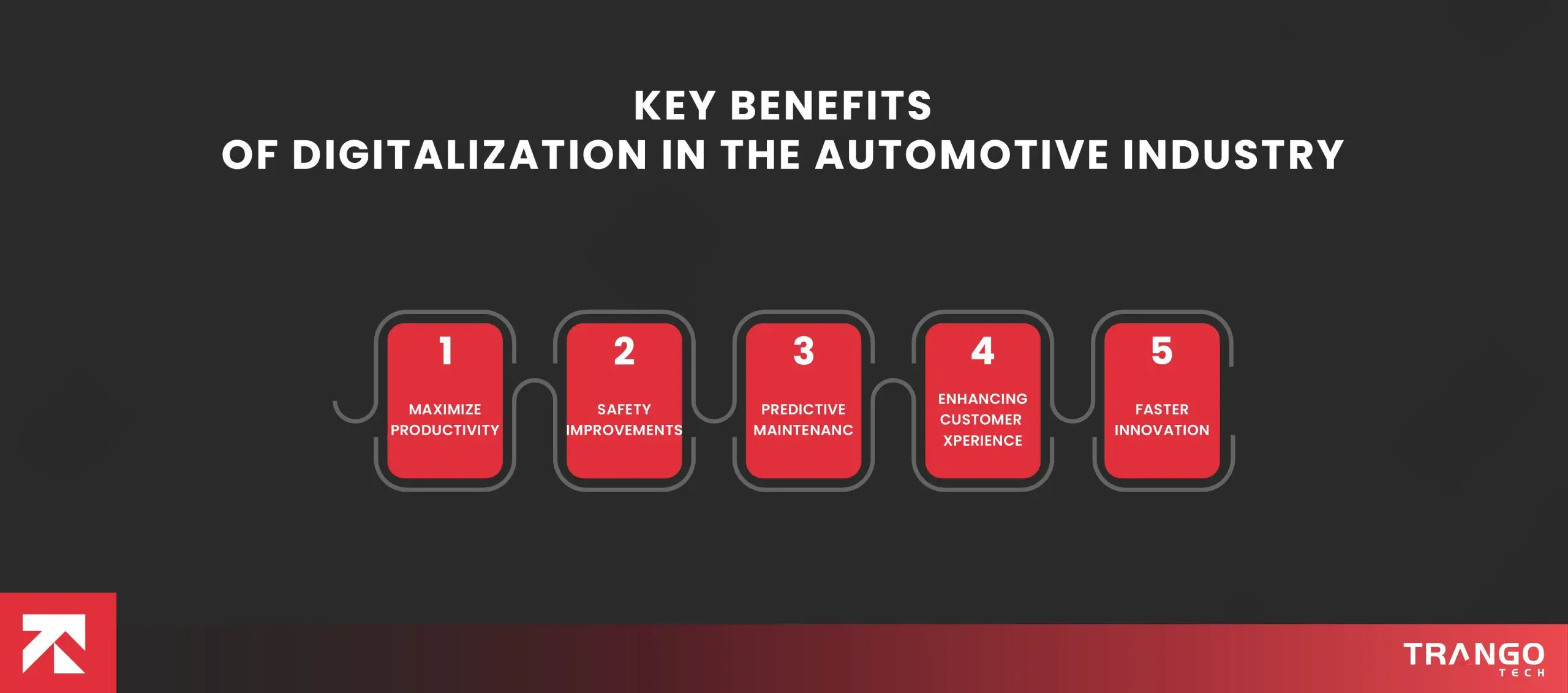
Key Benefits of Digitalization in the Automotive Industry:
Using digitization in the automotive industry in Detroit includes:
Maximize Productivity:
Technology and analytics have simplified manufacturing, enabling computer-assisted operations that lower production speed and costs.
This improvement in operational efficiency causes quick turnarounds in bringing new automobiles to the market.
Safety Improvements:
Digital solutions connect vehicles and the environment, providing accurate views of road conditions and traffic updates, while supporting additional security features, such as collision-avoidance systems that help prevent incidents.
Predictive Maintenance:
Real-time vehicle monitoring helps manage and schedule maintenance. Vehicle sensors can predict potential causes of risky flaws before they become dangerous.
Enhancing Customer Experience:
Digital tools let automakers personalize entertainment and navigation to driver preferences. Advanced connectivity allows over-the-air updates, enhancing and satisfying the customer experience.
Faster Innovation:
Digitization enables faster innovation by speeding up the testing and design phases of vehicle development. Virtual and augmented reality let designers test ideas before building prototypes.
The Future of the Detroit Automotive Industry:
As the automotive industry continues to grow, it is encouraged by sustainability, technological advancements, and global market integration.
These shifts present the city as the major hub of revolution and transformation while solving the modern challenges.
Sustainability and Green Initiatives:
Sustainability is the future of Detroit’s automotive industry. Automakers are looking to electric vehicles (EVs) to decrease carbon emissions.
Battery innovation is also a critical part of this innovation. Gigafactories are largely developing the advanced batteries with higher efficiency and longer lifespans.
Green manufacturing practices further improve the sustainability efforts. Automation reduces waste by improving the accuracy in the production process, supported by AI-driven quality control systems that minimize resource use.
The Role of Emerging Markets:
Emerging markets heavily influence Detroit’s automotive industry strategies by driving demand for creative vehicle solutions that meet diverse global needs.
Affordability is a key factor in regions like Southeast Asia and South America. So, the automakers focus on creating cost-efficient designs without compromising the quality and safety standards.
The implementation of electric mobility varies depending on infrastructure availability and government incentives. Also, it offers more export opportunities because international policies support greener transportation options.
Automotive Digitalization in Detroit with Trango Tech:
Trango Tech helps digitalize automotive businesses in Detroit. With a team of expert app developers, the company is proud to be recognized as a trusted app development firm in Detroit.
The team evaluates infrastructure and develops custom solutions to improve competitiveness and efficiency through operational management and automation.
Innovative technological solutions are provided according to business needs, enabling clients to move forward in the digital age. So, whether you’re looking for enterprise app development for the automotive industry or automotive software development in Detroit, we’ve got you covered.
Looking to scale your Automotive business?
Frequently Asked Questions:
What is digitalization in the automotive industry?
The combination of physical and digital worlds is reshaping the automotive industry. It is used to transform the product lifecycle, as NVIDIA’s automotive partners are doing.
What is Detroit’s biggest industry?
Detroit’s largest and dominant industry is automotive and mobility.
How does automotive digitalization in Detroit help businesses?
Automotive digitalization in Detroit helps businesses by increasing productivity, reducing development costs, and creating new revenue streams through connected services.
Qurat-ul-ain is a skilled content writer and proofreader with 4 years of experience creating compelling content across SaaS, mobile app company, and tech industries. She excels at defining brand voices and managing the full content lifecycle, from planning to execution. Currently working as a Senior Content Writer, she holds an MBA degree in Marketing.